
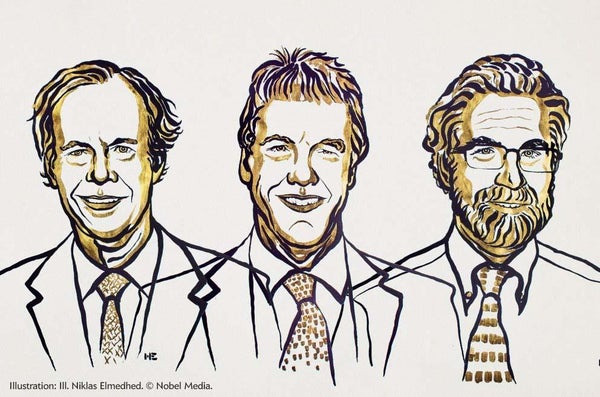

“The Nobel Assembly at Karolinska Institute has today decided to award the 2019 Nobel Prize in Physiology or Medicine jointly toWilliam Kaelin, Sir Peter Ratcliffe and Gregg Semenza for their discoveries of how cells sense and adapt to oxygen availability.”
Thomas Perlmann, secretary of the Nobel Assembly, shortly after 5:30 A.M. (Eastern Time).
“Gregg Semenza was born in 1956 in New York. He performed his prizewinning studies at Johns Hopkins University in Baltimore, where he’s still active. Sir Peter Ratcliffe was born in 1954 in Lancashire in the U.K. He performed his prizewinning studies at Oxford University. And he’s continuing to do his research at Oxford University, and he’s also at the Francis Crick Institute in London. And William Kaelin, born in 1957 in New York—he performed his prizewinning studies at the Dana-Farber Cancer Institute in Boston, where he’s still active in his own lab.”
On supporting science journalism
If you're enjoying this article, consider supporting our award-winning journalism by subscribing. By purchasing a subscription you are helping to ensure the future of impactful stories about the discoveries and ideas shaping our world today.
Karolinska Institute researcher Randall Johnson studies the effects of low oxygen. He explained the significance of the work of the new Nobel laureates:
“This year’s Nobel Prize is awarded for determining how oxygen levels are sensed by cells. Oxygen is essential for life and is used by virtually all animal cells in order to convert food to usable energy. However, the amount of oxygen available to cells, tissues and animals themselves can vary greatly. This prize is for three physician-scientists who found the molecular switch that regulates how our cells adapt when oxygen levels drop.
“Applications of these findings are already beginning to make their way to the clinic, with potential drugs used to treat anemia and to treat some forms of cancer. These fundamental findings have greatly increased our understanding of how the body adapts to change. And applications of these findings are already beginning to affect the way medicine is practiced. This year’s three laureates have greatly expanded our knowledge of how physiological response makes life possible.”
For an in-depth listen about the 2019 Nobel Prize in Physiology or Medicine, look for the Scientific American Science Talk podcast later today.
—Steve Mirsky
[The above text is a transcript of this podcast.]
