Nobelist Crafts Light-Switchable Antibiotics

Drugs modified by chemistry Nobel laureate Ben Feringa can be turned on and off by light, which could help keep bacteria from developing antibiotic resistance.

Sam Leakey, Programme Specialist Science, World Economic Forum

Illustration of a Bohr atom model spinning around the words Science Quickly with various science and medicine related icons around the text

Join Our Community of Science Lovers!

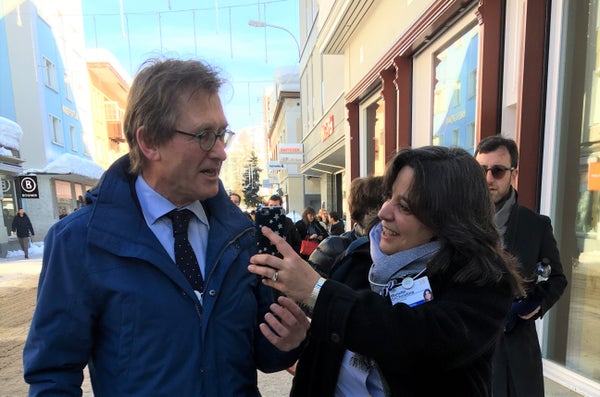
Yesterday, January 24th, 2018, at the World Economic Forum in Davos, Scientific American Editor in Chief Mariette DiChristina ran into Ben Feringa. He shared the 2016 Nobel Prize for chemistry for designing and creating molecules that function as microscopic machines.

[DiChristina:] Ben Feringa and I are walking through Davos about to go to our next appointment. And I was just asking Professor Feringa, what was exciting to him right now?

[Feringa:] The most exciting thing probably we’re working on now is to make antibiotics that we can switch with light. So we have, you know antibiotics is a real big problem, antibiotic resistance, and what we do is we build in light switches in antibiotics, and they’re off, and then we can switch them on with light, and after 24 hours when they have done their job, they switch off automatically. And the bugs don’t build up resistance. And it works. And recently we got it done with red light, and that’s really exciting, because now we can get light into the body, because red light…


On supporting science journalism

If you're enjoying this article, consider supporting our award-winning journalism by subscribing. By purchasing a subscription you are helping to ensure the future of impactful stories about the discoveries and ideas shaping our world today.


[MD:] ...goes deeper.

[BF:] Goes very deep in the body. And that gives us a lot of opportunities to develop these smart drugs.

For a video of a longer conversation between Mariette DiChristina and Ben Feringa go to the World Economic Forum homepage, and search for Ben Feringa.

—Steve Mirsky

[The above text is a transcript of this podcast.]

Mariette DiChristina, Steering Group chair, is dean and professor of the practice in journalism at the Boston University College of Communication. She was formerly editor in chief of Scientific American and executive vice president, Magazines, for Springer Nature.

More by Mariette DiChristina

Steve Mirsky was the winner of a Twist contest in 1962, for which he received three crayons and three pieces of construction paper. It remains his most prestigious award.

More by Steve Mirsky

It’s Time to Stand Up for Science

If you enjoyed this article, I’d like to ask for your support. Scientific American has served as an advocate for science and industry for 180 years, and right now may be the most critical moment in that two-century history.

I’ve been a Scientific American subscriber since I was 12 years old, and it helped shape the way I look at the world. SciAm always educates and delights me, and inspires a sense of awe for our vast, beautiful universe. I hope it does that for you, too.

If you subscribe to Scientific American, you help ensure that our coverage is centered on meaningful research and discovery; that we have the resources to report on the decisions that threaten labs across the U.S.; and that we support both budding and working scientists at a time when the value of science itself too often goes unrecognized.

In return, you get essential news, captivating podcasts, brilliant infographics, can't-miss newsletters, must-watch videos, challenging games, and the science world's best writing and reporting. You can even gift someone a subscription.

There has never been a more important time for us to stand up and show why science matters. I hope you’ll support us in that mission.

Thank you,

David M. Ewalt, Editor in Chief, Scientific American

Subscribe