
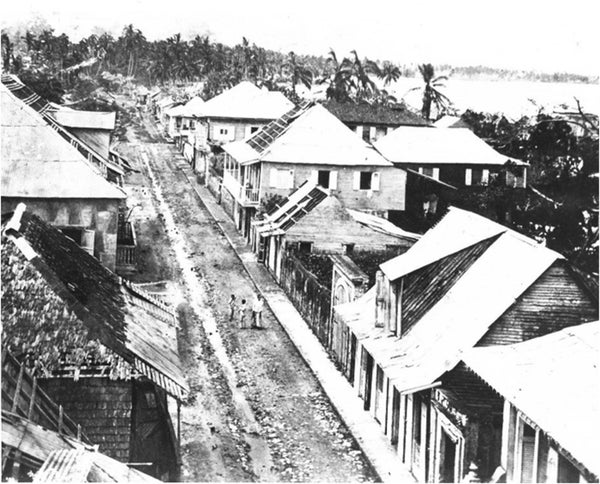

Ninety-nine years ago, a magnitude 7.3 earthquake hit Puerto Rico. It also caused a tsunami that swept through coastal towns. All told, the shaking and flooding killed more than 100 people and damaged many buildings and roads. Now, scientists are getting a clearer picture of the tragic event thanks to an unexpected source: century-old documents unearthed in an archive in the capital city of San Juan.
The documents were discovered by Bill McCann, a seismologist and former professor at the University of Puerto Rico. McCann stumbled upon boxes of repair petitions filed by residents of what was then a newly acquired U.S. territory, asking for aid after the disaster. He later mentioned them to Roland LaForge, another semi-retired seismologist, who told me why he wanted to rescue the records:
“They’re just sitting there getting moldy, and nobody’s ever looked at them. There might be some really useful information in there.”
On supporting science journalism
If you're enjoying this article, consider supporting our award-winning journalism by subscribing. By purchasing a subscription you are helping to ensure the future of impactful stories about the discoveries and ideas shaping our world today.
So the two researchers analyzed more than 6000 documents. Which turned out to be a gold mine of information about the disaster and the damage it caused, on a house-by-house basis.
“They’re very sad and pointed at times, because people lost family members. Some people drowned and they never found their bodies. You got a real feel for the suffering that these people went through.”
In a newly published study based on the records, the researchers focused on the town of Aguadilla, which sat closest to the epicenter. They found that the worst earthquake damage happened where the ground was sandy or swampy, and confirmed earlier estimates that the tsunami rose between three and four meters high, inundating low-lying neighborhoods. LaForge says these data will help local authorities plan for future quakes.
“It’s very important to look at these historic earthquakes and learn as much as you can from them because our knowledge and our history of earthquakes is very, very short.”
The work is published in the journal Seismological Research Letters. [Roland LaForge and William R. McCann, Address‐Level Effects in Aguadilla, Puerto Rico, from the 1918 Mw 7.3 Earthquake and Tsunami]
The 1918 event was the most recent major earthquake to hit Puerto Rico, and the only one for which any written records exist. But LaForge says it’s only a matter of time before the island experiences another. It sits on its own tiny plate, squeezed between the North American and Caribbean plates and surrounded on all sides by faults. LaForge has estimated that it could be a few thousand years before the fault that caused the 1918 disaster breaks again. But that’s what he calls a WAG—“you know, a wild-ass guess.” Besides, there are many other faults just like it that could go.
“If a repeat of that type of earthquake happened next week, nobody would be surprised.”
—Julia Rosen
[The above text is a transcript of this podcast.]
