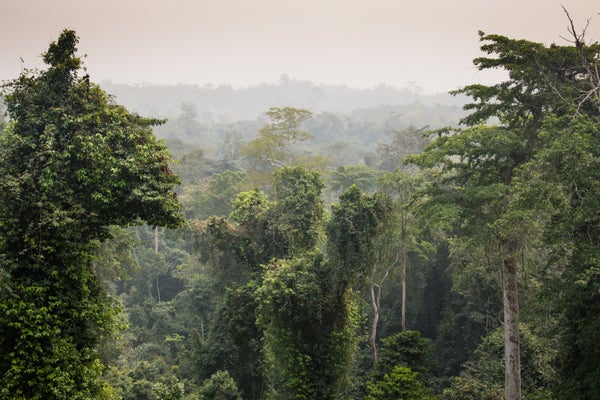
Old Trees Are Ecosystem Gold

David Lindenmayer of the Australian National University College of Science in Canberra says that older trees play outsize roles in maintaining landscapes and ecosystems.

Illustration of a Bohr atom model spinning around the words Science Quickly with various science and medicine related icons around the text

Join Our Community of Science Lovers!

“Well, lots of people recognize that as humans get older they tend to have less and less children...trees do it the other way around.”

David Lindenmayer. He studies conservation, landscape ecology and biodiversity at the Australian National University College of Science in Canberra. On January 26th he spoke to Scientific American Editor in Chief Mariette DiChristina when they were both at the World Economic Forum in Davos.

DL: “What happens is that the older some of these really big old trees get, the more seeds they produce and the more germinants they’re likely to have. So it’s actually the polar opposite of what we see with humans and most other animals, so really quite extraordinary.”


On supporting science journalism

If you're enjoying this article, consider supporting our award-winning journalism by subscribing. By purchasing a subscription you are helping to ensure the future of impactful stories about the discoveries and ideas shaping our world today.


Mariette DiChristina: “And how about the number of older trees that we have today, how does that look?”

DL: “It’s quite a distressing situation, because in many, many forests and woodland and other ecosystems around the world, populations of large old trees are declining very, very quickly. And this matters because a lot of biodiversity, a lot of carbon, a lot of key ecosystem processes are associated with those really big, old trees.”

MD: “Is there something we can do about this?”

DL: “Absolutely there is. We can make sure we grow more forest, we can make sure we protect the big trees that we have now, and we can make sure that we don’t do things that really put a lot of pressure on those trees. Straight out, just cutting them down—we should not be cutting down really big, old trees anymore.”

—Steve Mirsky

[The above text is a transcript of this podcast.]

Mariette DiChristina, Steering Group chair, is dean and professor of the practice in journalism at the Boston University College of Communication. She was formerly editor in chief of Scientific American and executive vice president, Magazines, for Springer Nature.

More by Mariette DiChristina

Steve Mirsky was the winner of a Twist contest in 1962, for which he received three crayons and three pieces of construction paper. It remains his most prestigious award.

More by Steve Mirsky

It’s Time to Stand Up for Science

If you enjoyed this article, I’d like to ask for your support. Scientific American has served as an advocate for science and industry for 180 years, and right now may be the most critical moment in that two-century history.

I’ve been a Scientific American subscriber since I was 12 years old, and it helped shape the way I look at the world. SciAm always educates and delights me, and inspires a sense of awe for our vast, beautiful universe. I hope it does that for you, too.

If you subscribe to Scientific American, you help ensure that our coverage is centered on meaningful research and discovery; that we have the resources to report on the decisions that threaten labs across the U.S.; and that we support both budding and working scientists at a time when the value of science itself too often goes unrecognized.

In return, you get essential news, captivating podcasts, brilliant infographics, can't-miss newsletters, must-watch videos, challenging games, and the science world's best writing and reporting. You can even gift someone a subscription.

There has never been a more important time for us to stand up and show why science matters. I hope you’ll support us in that mission.

Thank you,

David M. Ewalt, Editor in Chief, Scientific American

Subscribe