

Imagine you had never tasted lemonade. You would still probably assume that lemon juice mixed with sugar tastes better than lemon juice alone. Because you know what lemons taste like, and you know what sugar tastes like.
You can recall those past experiences, and make a prediction about your response to something new. Researchers call the ability to predict our future emotional state "affective forecasting." And some have suggested that the skill is unique to humans. But is it?
"We combined different liquids and asked participants, the orangutan and the humans, to predict how such novel liquid combinations taste like, and whether they prefer one or the other." Lund University cognitive scientist Gabriela-Alina Sauciuc.
On supporting science journalism
If you're enjoying this article, consider supporting our award-winning journalism by subscribing. By purchasing a subscription you are helping to ensure the future of impactful stories about the discoveries and ideas shaping our world today.
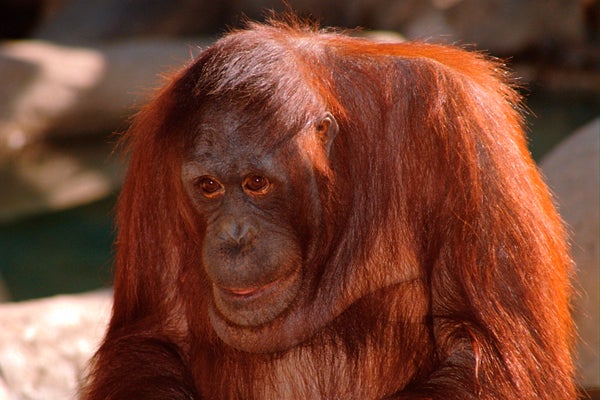
She and her colleagues offered their cocktails to a 21-year-old male Sumatran orangutan named Naong, who lives in Sweden's Furuvik Zoo. They used four ingredients—cherry juice, rhubarb juice, lemon juice, and diluted apple cider vinegar—which they combined into six unfamiliar mixtures. Altogether, that made for 24 possible comparisons of one drink against another.
Naong watched the researchers mix his drinks. Then he got to choose from the two set before him. And in 21 of the 24 trials, Naong matched the researchers’ predictions: that his choice would be based on his relative fondness for the separate ingredients. [Gabriela-Alina Sauciuc, et al., Affective forecasting in an orangutan: predicting the hedonic outcome of novel juice mixes, in Animal Cognition]
For example, since he liked rhubarb juice better than lemon juice, he also preferred rhubarb-cherry juice to lemon-cherry juice—despite having had no experience with either.
"We were impressed with Naong's ability to be so consistent in his choices."
From a statistical perspective, the orangutan data was indistinguishable from human data. Both species seemed to make consistent choices about future events even if they had no prior experience to guide their decision-making.
"An ability which was previously thought to be uniquely human presumably has evolved earlier, so that it's shared with orangutans and presumably with chimpanzees as well."
It’s a single study with a single orangutan. But it may be that we will soon mark yet another skill off the list of things that were once thought to be the sole domain of our species. Perhaps what's truly unique about us is our ongoing quest to find something unique about us.
—Jason G. Goldman
[The above text is a transcript of this podcast.]
