
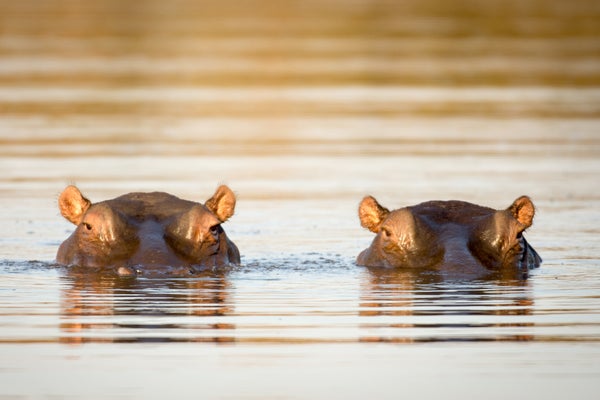

Around 115 miles east of Medellín, in Colombia, sits the enormous hacienda built by the drug lord Pablo Escobar—who had his own personal zoo, which included hippos. When Escobar’s empire fell, most of the exotic animals were safely relocated—except for the hippos, who eventually escaped.
“So he brought four from a zoo in the U.S. to Colombia, and they lived at his ranch. And they’ve grown slowly but steadily.”
Jonathan Shurin, ecologist from the University of California in San Diego.
On supporting science journalism
If you're enjoying this article, consider supporting our award-winning journalism by subscribing. By purchasing a subscription you are helping to ensure the future of impactful stories about the discoveries and ideas shaping our world today.
The original population of four in 1981 is estimated to be at least 80 now. Hippos have a tremendous influence on their native ecosystems in Africa, so Shurin wanted to see how they might be affecting their new ecosystem in Colombia.
“It shouldn’t be a surprise to anybody that hippos poop in the water in South America, just as they do in Africa.”
Hippos on both continents wallow in ponds and lakes, where their droppings release a tremendous amount of nutrients into the water.
“That imported material stimulates photosynthesis of algae and aquatic plants and also microbial bacterial production—bacteria that are living off of the organic matter that’s imported.”
And that’s where the hippos can cause ecological trouble. If there is too much photosynthesis occurring, then the water becomes full of oxygen during the daytime. But at night, when the sun goes down, and the plants and algae stop releasing oxygen into the water, a phenomenon called eutrophication occurs. All the creatures that consume oxygen keep consuming it, and the overall amount of oxygen dissolved in the water becomes critically low.
“The oxygen dropping low enough—you can have all the fish sort of croaking and going belly-up.”
The researchers also say the situation provides a unique glimpse into the way that massive mammals like mammoths and mastodons, long extinct in the New World, may have influenced their habitats prior to their extinction.
But they also note that unless we can somehow curtail their population growth, the hippo population could explode in the next couple of decades—at which point, they will disrupt larger and wilder river systems. The study is in the journal Ecology. [Jonathan B. Shurin et al., Ecosystem effects of the world’s largest invasive animal]
Lethal control isn’t a popular management strategy among people who love hippos or see them as a valuable tourism attraction. But the question is when, not if, the hippos become detrimental to Colombian ecology—which means that folks should be thinking about the best way to solve the problem now, when there are fewer than a hundred hippos to manage and not thousands.
—Jason G. Goldman
[The above text is a transcript of this podcast.]
