
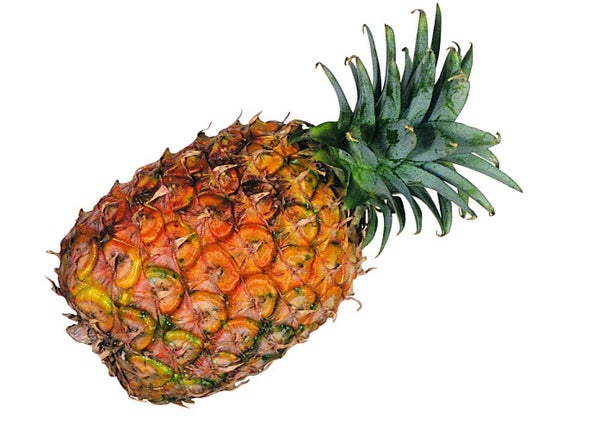

Pineapples—just thinking about this delicious tropical fruit, rich in vitamin C, might make your mouth water. But have you ever stopped to think where the peel and other waste from this crop end up?
We do here in the small country of Costa Rica, the world’s largest producer of pineapples. Pineapple production generates about 4.5 million tons of crop residues every year in our Central American nation.
And that waste is tough stuff. The plant is made of strong cellulose that takes a long time to biodegrade. And most of it is either burnt or ends up dumped in open forests, where disease-causing mosquitoes and fungi thrive off its high sugar content.
On supporting science journalism
If you're enjoying this article, consider supporting our award-winning journalism by subscribing. By purchasing a subscription you are helping to ensure the future of impactful stories about the discoveries and ideas shaping our world today.
But hidden in pineapple peels is a treasure—of nanomaterials. Scientists at Costa Rica’s National Laboratory of Nanotechnology (LANOTEC) have been extracting valuable nanocellulose from the peel and stubble of the pineapple. This nanocellulose can be used in the pharmaceutical, food and medical industries.
And it turns out that, while harvesting that nanocellulose, you can also get rosettelike silica-based microparticles. These tiny traces have potential as reinforcement in adhesives, in the biomedical field, and even as a source of silica for fertilizers. Scientists from LANOTEC describe these applications in the journal Scientific Reports. [Yendry R. Corrales-Ureña et al., Biogenic silica-based microparticles obtained as a sub-product of the nanocellulose extraction process rom pineapple peels]
José R. Vega-Baudrit is the director of LANOTEC and one of the authors of the paper. “Pineapple residue is something that has been studied a lot, but nobody had seen this particle in the skin of the fruit.”
It was chemical engineer and material scientist Yendry Corrales-Ureña who noticed the silica-based microparticles.
“I began to study the plant, to make the cuts, to see what it had, and incredibly, after doing the synthesis, I began to see those rosettes, like flowers, that did not fall apart under duress. It was wonderful. We had thousands, millions, of the same structures left over.”
The pineapple silica differs from silica nanospheres that are synthesized in labs for various applications.
YCU: “This is a silica that the pineapple plant processes on its own, and it is of very high purity.”
Most commercial fertilizers use silica. And Corrales-Ureña’s main interest in the rosettelike silica-based microparticles is as a fertilizer component. The next steps in that line of research will be to determine if parts other than the peels also have silica nanoparticles, and to develop an efficient fertilizer using them.
—Debbie Ponchner
[The above text is a transcript of this podcast.]

