
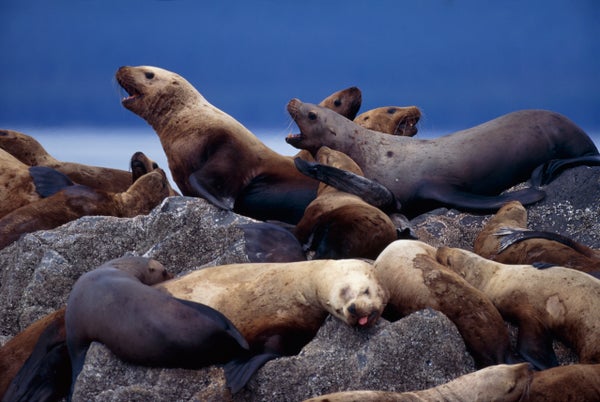

Cabo Polonio is a small seaside village on Uruguay's Atlantic coast. The permanent, year-round population is just 95 people living in around 50 homes. Another 350 homes are used between December and February—by tourists hoping to see pinnipeds—
—fur seals and sea lions that haul out on the town’s rocky cape.
On supporting science journalism
If you're enjoying this article, consider supporting our award-winning journalism by subscribing. By purchasing a subscription you are helping to ensure the future of impactful stories about the discoveries and ideas shaping our world today.
In January alone, more than 30,000 tourists visit. What are the impacts of so many tourists on these marine mammals? Between 1996 and 2014, European and South American biologists monitored both the animals and the people to find out.
Over that time span, the pinnipeds' tolerance for human disturbance declined. When annoyed, they move further away from the tourist viewing area or even dive back in the water to swim away. Those responses are contrary to the common assumption that wildlife becomes habituated to human activities. The study is in the journal Applied Animal Behaviour Science. [Carme Tuneu Corral, et al., Short- and long-term changes in the intensity of responses of pinnipeds to tourist approaches in Cabo Polonio, Uruguay.]
The researchers think that a fence, initially constructed in the late 1990s, is to blame. It was built with good intentions, to keep people a safe distance from the colony. But the fence isn't long enough to keep people away from the most critical part of the habitat. It might even funnel people towards that area, as they try to find viewing spots closer than the fence would allow.
Or it could be that the fence actually does its job keeping people away. But as a result, they are just far enough away that the animals never really get used to them.
The truth is that pinnipeds seem to be doing well in Uruguay. While the amount of animals in the rookery varies day by day, the best estimate is there's now around a thousand of them—more than there were 20 years ago. But it's hard to say whether tourism has played any role in that increase. The animals have also become protected from hunting under Uruguayan law. And there are environmental factors at play in governing their population, like prey availability and climate change.
Still, the study tells us two things. First, photographic wildlife tourism may not always be as low-impact as assumed. Second, ecotourism developers should get input from social psychologists: who can help anticipate the behaviors of the visiting humans, as they observe the behaviors of the native wildlife.
—Jason G. Goldman
[The above text is a transcript of this podcast.]
