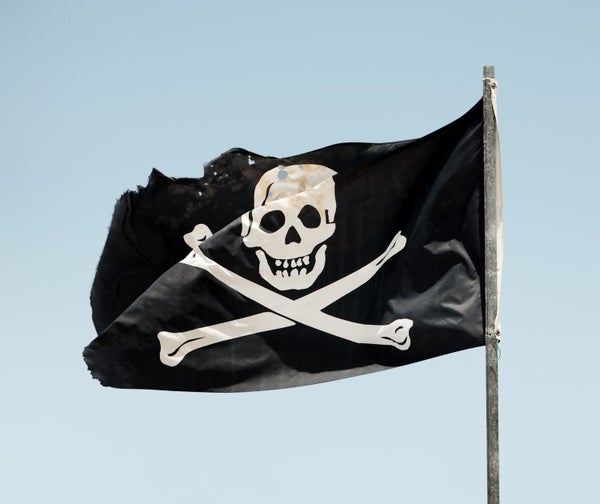
Pirates Needed Science, Too

On International Talk Like a Pirate Day, here's an eye-patch-witness account of how science helps in all peg-leg walks of life, even piracy

Illustration of a Bohr atom model spinning around the words Science Quickly with various science and medicine related icons around the text

Join Our Community of Science Lovers!

Arrrrr. Today, September 19th, is International Talk Like A Pirate Day.

No, seriously, yo ho ho, check the web. Ya know, matey, anyone could be a pirate, all ye needed was a proper disrespect for authority and a willingness to be seasick months at a time. But to be a truly successful pirate and not just the son of a biscuit eater, well, ye had to know a bit of science, too.

A good pirate captain had to know the astronomy to navigate by the stars. He had to be acquainted with meteorology and know enough fluid dynamics to make sure he didn’t overload his ship with booty. And he needed the psychological skills to manage his literally motley crew.


On supporting science journalism

If you're enjoying this article, consider supporting our award-winning journalism by subscribing. By purchasing a subscription you are helping to ensure the future of impactful stories about the discoveries and ideas shaping our world today.


Your average pirate ship required a buccaneer surgeon to treat stab wounds and cat o’ nine tails slashes, and a swashbucklin’ general practitioner to make sure the men had the right diet to ward off scurvy with foods rich in vitamin C. Plus, your pirate optometrist supplied the men with eye patches. And of course, advanced veterinary practice kept your pirate parrots in fine fettle. So ya see, me hearty, no matter what your chosen path, science is sure to give you a hand. Or at least a hook .

—Pirate Steve

[Originally posted on September 19, 2006.]

[The above text is pretty much an exact transcript of this podcast, more or less, arrrrrrrrgh.]

It’s Time to Stand Up for Science

If you enjoyed this article, I’d like to ask for your support. Scientific American has served as an advocate for science and industry for 180 years, and right now may be the most critical moment in that two-century history.

I’ve been a Scientific American subscriber since I was 12 years old, and it helped shape the way I look at the world. SciAm always educates and delights me, and inspires a sense of awe for our vast, beautiful universe. I hope it does that for you, too.

If you subscribe to Scientific American, you help ensure that our coverage is centered on meaningful research and discovery; that we have the resources to report on the decisions that threaten labs across the U.S.; and that we support both budding and working scientists at a time when the value of science itself too often goes unrecognized.

In return, you get essential news, captivating podcasts, brilliant infographics, can't-miss newsletters, must-watch videos, challenging games, and the science world's best writing and reporting. You can even gift someone a subscription.

There has never been a more important time for us to stand up and show why science matters. I hope you’ll support us in that mission.

Thank you,

David M. Ewalt, Editor in Chief, Scientific American

Subscribe