
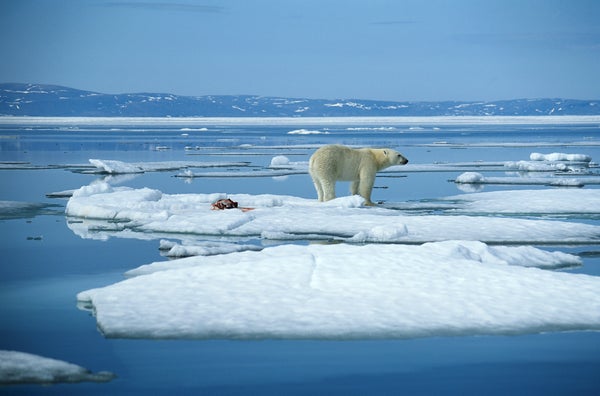

Polar bears live on floating rafts of sea ice, hunting for seals. But in the Arctic Ocean north of Alaska, the cold polar wind constantly blows that ice from east to west. Which means that the polar bears there are on a kind of treadmill.
“If the bears don’t compensate that drift, they would all drift to Russia. So over the course of a year they need to walk back against that prevailing drift to remain in the Alaska territories.” David Douglas, a biologist with the U.S. Geological Survey in Juneau, Alaska.
On supporting science journalism
If you're enjoying this article, consider supporting our award-winning journalism by subscribing. By purchasing a subscription you are helping to ensure the future of impactful stories about the discoveries and ideas shaping our world today.
Recently, researchers realized that the ice drift in this part of the Arctic Ocean has accelerated from about three kilometers per day up to five. That’s probably because climate change has made the sea ice thinner and easier for the winds to push. And that means the polar bear treadmill has sped up too.
Douglas and his colleagues tracked Alaskan polar bears fitted with radio collars. They found that the animals are working harder than ever to compensate for the faster drift. And just like when we exercise, bears have to eat more food to make up for the extra calories they’re burning—between one and four more seals per year, depending on whether the bears are single or raising cubs.
“While that may not seem like a lot of seals or a big demand, it also comes at a time when the habitat that they have to hunt in is shrinking. So they have less area on which to hunt seals, at the same time needing to hunt more.”
Douglas, after presenting the research December 15th at the fall meeting of the American Geophysical Union in San Francisco. [David Douglas et al, Increased Arctic Sea Ice Drift Alters Polar Bear Movements and Energetics]
He’s particularly worried that the changes in sea ice may hurt young bears’ chances of survival, especially in the southern Beaufort Sea, north of Prudhoe Bay. Researchers have studied these bears for more than 30 years, and have watched their numbers decline.
“We didn’t see this coming three decades ago when we started tracking bears. We thought we were simply getting baseline data on a population, and never foresaw that the Arctic would undergo such dramatic change.” That, like the sea ice, may be accelerating.
—Julia Rosen
[The above text is a transcript of this podcast.]
