

Baleen whales feed by opening their gigantic maws, lunging forward in the water and engulfing gallons of seawater in their mouths. They strain the seawater back through their baleen plates, trapping vast numbers of tiny critters—fish, krill and others—that then get swallowed all at once. The species that share this method include what are called the rorqual whales, which include fin whales, sei whales, blue whales and humpback whales.
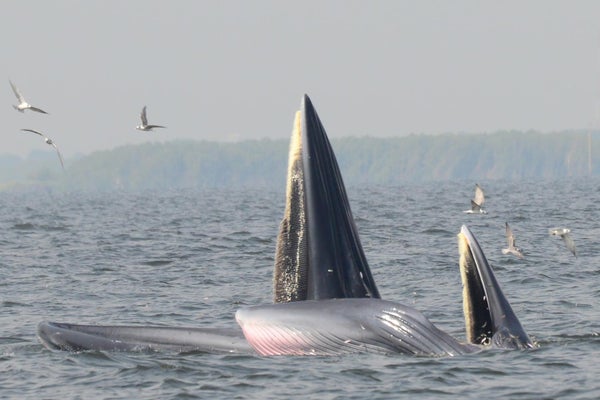
But now a team of Japanese and Thai researchers has discovered a never-before-seen type of feeding behavior in a rorqual called a Bryde's whale. These whales don’t bother with the lunge. They simply open their mouths at the surface and let the seawater flow in, before straining and expelling the seawater through their baleen as usual.
The researchers call it tread-water feeding because of the way the whales gently undulate their tails to keep their heads near the surface of the water. They say it’s the first passive feeding strategy ever seen in a baleen whale. The team, led by Takashi Iwata from the University of Tokyo, observed 31 different whales feed this way in the Gulf of Thailand.
On supporting science journalism
If you're enjoying this article, consider supporting our award-winning journalism by subscribing. By purchasing a subscription you are helping to ensure the future of impactful stories about the discoveries and ideas shaping our world today.
Tread-water feeding is more energy-efficient than lunge-feeding, since the whales just have to bob their heads near the surface. But Iwata thinks that the odd behavior may have a darker origin.
The upper Gulf of Thailand is hypoxic—there’s a serious lack of oxygen dissolved in the water, thanks mostly to sewage that flows into the sea from nearby rivers. The low oxygen levels might force the whales' prey towards the surface, where oxygen is a bit more plentiful. And if all the food is in one spot, then tread-water feeding might be the only way to get enough nutrition. Which means that these whales apparently improvised an improved strategy for survival in their polluted habitat. [Takashi Iwata et al., Tread-water feeding of Bryde's whales, in Current Biology]
Iwata wrote in an e-mail that his team witnessed tread-water feeding most often in adult-calf pairs. That observation leads him to suspect that the behavior might be socially learned, passed from parents to their offspring via imitation.
If that's true, then tread-water feeding could represent a form of culture, unique to the Bryde's whales that live in the Gulf of Thailand.
—Jason G. Goldman
[The above text is a transcript of this podcast.]
