
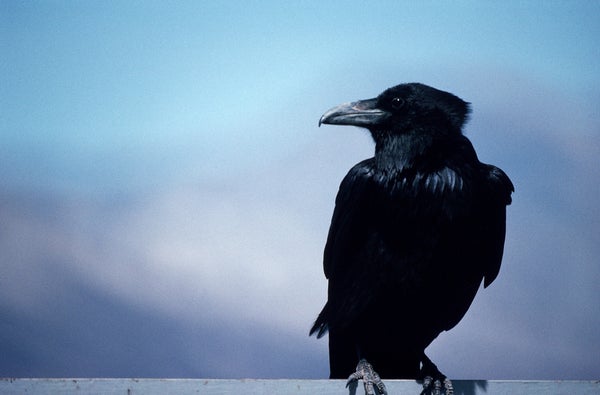

There's a well-known conspiracy of ravens—that's what you call a group of ravens—that likes to hang out near a zoo in the Austrian Alps. Every day these ravens conspire to steal the food that's set out for the wild boars there.
"So we have a really great opportunity to really watch those individuals daily. "
University of Vienna cognitive biologist Markus Boeckle. He spends lots of time ignoring the zoo animals and watching the ravens.
On supporting science journalism
If you're enjoying this article, consider supporting our award-winning journalism by subscribing. By purchasing a subscription you are helping to ensure the future of impactful stories about the discoveries and ideas shaping our world today.
"And what we found is that every time they come they do those food calls, which is very typical for the ravens when they are close to potentially dangerous food resources."
[Raven haa call sounds]
The ravens use these calls to recruit their buddies to show up, both to reduce potential dangers from predators and to overpower dominant ravens who might be trying to hoard all the food for themselves.
But Boeckle and his colleagues began to suspect the calls revealed other information.
"So we had the feeling we could say, this is a juvenile, this is a sub-adult, and this is most probably an adult, just by listening to the calls."
If the researchers could use the calls to distinguish among ravens, then perhaps the ravens themselves could do so too. So Boeckle and his team recorded the calls of around a hundred known individuals—all of which had previously been catalogued by weight, age and sex and were identifiable by colored leg bands.
The researchers combined that data with the acoustic properties of their calls and dumped everything into a computer program. And as they suspected, there were differences in the frequency, duration, and amplitude of the calls that could sort the ravens according to sex and age. The results were published in the journal Frontiers in Zoology. [Markus Boeckle et al., Raven food calls indicate sender's age and sex.]
"So the benefit is, especially for birds like ravens who travel long distances every day, that whenever you encounter a new individual, or listen to a new individual, you are already able to categorize one of the birds just based on the calls…. So this really helps to assess whether you're going to be in an aggressive situation or whether you're going to be the more dominant individual, just by listening to the call."
To be clear, the researchers showed that they could categorize ravens according to their calls, not that ravens actually do so. That's what Boeckle and his team are working on now.
Still, the study shows that while a call can primarily refer to some external object, like food, it can also transmit additional social information. And since these sorts of calls are thought of as the precursors for language, this study might shed light on how a simple system for communication can evolve into something far more complex—such as me talking to you now.
—Jason G. Goldman
[The above text is a transcript of this podcast.]
