

As animals grow, the sounds they make change. But some sounds continue to change, even after an animal matures. That's true for humans, and now it turns out to be true for North Atlantic right whales, too.
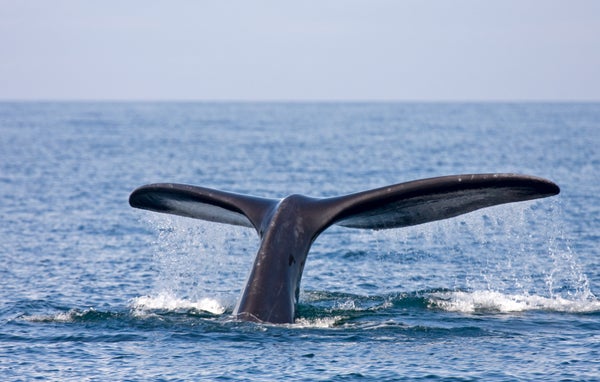
A member of the baleen family of whales, the endangered North Atlantic right whales spend most of their time along the eastern coast of North America from Canada's Bay of Fundy south to Florida.
Syracuse University biologist Holly Root-Gutteridge analyzed recordings of whale calls to see if researchers could use those sounds to identify individual whales. In an audio program on a computer screen, a call has a particular shape.
On supporting science journalism
If you're enjoying this article, consider supporting our award-winning journalism by subscribing. By purchasing a subscription you are helping to ensure the future of impactful stories about the discoveries and ideas shaping our world today.
"Staring at these calls all day, I started to notice they were changing. And then we looked a little bit harder at the data, and realized that they weren't just changing from being a little tiny baby to being a fair sized adult…but that they kept changing over time."
Root-Gutteridge and her colleagues rounded up seventeen years' worth of whale recordings. In all, they gathered nearly a thousand calls from 49 individual whales between the ages of one month and 37 years.
Like many other animals, the calls of the infants were both shorter and less structured than those of the adults. Mature whales produced calls that were clearer, longer, and more structurally complex. But the researchers also found that the calls continued to develop long after the whales reached sexual and physical maturity.
"Instead of just changing from the age of 0 to 15 when they're pretty much full-grown, they kept changing after the age of 15 and just kept going throughout their whole lives. Compared to say, a bird, where usually they get to their full-grown state and then they don't change these calls."
The results were published in the journal Animal Behaviour. [Holly Root-Gutteridge, et al., A lifetime of changing calls: North Atlantic right whales, Eubalaena glacialis, refine call production as they age]
"Well, it means that instead of having a completely instinctive reaction where they always make the same call in response to the same stimuli—a reflex, basically—that the whales are capable of changing what they're calling and how they're communicating. Which means that they may be thinking about what they call."
In other words, understanding the calls of North Atlantic right whales might shed some light on the minds of North Atlantic right whales.
In the meantime, scientists announced recently that they did not observe any newly born North Atlantic right whales this year—bad news for an already imperiled species. With luck, the work of biologists like Root-Gutteridge might offer insights that help us we try to help them survive.
—Jason G. Goldman
[The above text is a transcript of this podcast.]
[Final whale audio from Susan Parks, Syracuse University]
