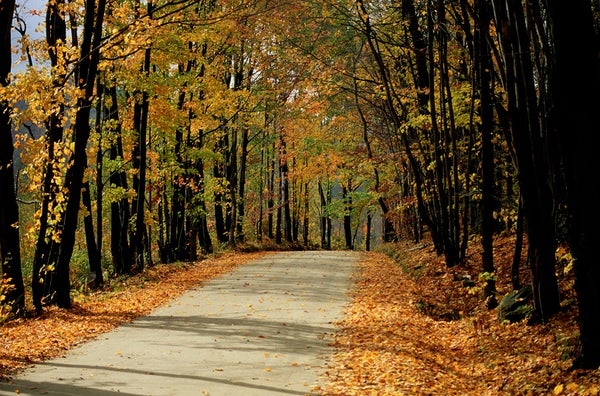
Road Noise Makes Birds' Lives Tougher

By playing road noise where there was no road, researchers were able to gauge the effect of the noise on bird behavior without having to deal with the effect of the road itself.


PhotoDisc/Getty Images (MARS)

Illustration of a Bohr atom model spinning around the words Science Quickly with various science and medicine related icons around the text

Join Our Community of Science Lovers!

[Songbird and traffic noise]

It's hard to be a bird in our human-dominated world.

You can barely hear yourself sing, let along hear the songs of your friends… and you can forget about hearing a predator. Noise is almost everywhere. Especially noise from traffic. A whopping 83 percent of the surface of the continental U.S. is within just one kilometer of a road.


On supporting science journalism

If you're enjoying this article, consider supporting our award-winning journalism by subscribing. By purchasing a subscription you are helping to ensure the future of impactful stories about the discoveries and ideas shaping our world today.


Researchers have tried to assess the impact of road noise on animals by, understandably, looking at animals living near noisy roads. The problem is that noisy roads are both noisy, and well, they're roads. It's hard to separate the two.

"And so we figured out a way to have just the noise without any of the other effects of the road, and to do that we ran speakers through a forest where there was no road."

Chris McClure, a biologist at Boise State University and The Peregrine Fund. He and his team built their audio phantom road at a popular stopover site for birds in Idaho as they fly south for the winter.

While the noise kept lots of birds away, some stuck around. But they had trouble putting on enough weight to fuel the next leg of their migratory journey.

"They have to fatten up but they also have to not get eaten by a predator. And those two things are in conflict. Because to eat, they have to look down, which means they aren't looking at predators."

And when it's too loud, they can't hear the alarm calls of other birds. So they have to waste time looking for predators instead of foraging. The study is in the journal Animal Conservation. [C.J.W. McClure et al., Noise from a phantom road experiment alters the age structure of a community of migrating birds]

By 2050, it's thought that enough new roads will be built to circle the planet more than 600 times. But there's an easy solution to the noise problem.

"Lowering speed limits does a lot."

So next time you're driving through nature, just slow down a little. It’s safer for you and the wildlife. And you can enjoy the view a little longer.

—Jason G. Goldman

[The above text is a transcript of this podcast.]

Jason G. Goldman is a science journalist based in Los Angeles. He has written about animal behavior, wildlife biology, conservation, and ecology for Scientific American, Los Angeles magazine, the Washington Post, the Guardian, the BBC, Conservation magazine, and elsewhere. He contributes to Scientific American's "60-Second Science" podcast, and is co-editor of Science Blogging: The Essential Guide (Yale University Press). He enjoys sharing his wildlife knowledge on television and on the radio, and often speaks to the public about wildlife and science communication.

More by Jason G. Goldman

It’s Time to Stand Up for Science

If you enjoyed this article, I’d like to ask for your support. Scientific American has served as an advocate for science and industry for 180 years, and right now may be the most critical moment in that two-century history.

I’ve been a Scientific American subscriber since I was 12 years old, and it helped shape the way I look at the world. SciAm always educates and delights me, and inspires a sense of awe for our vast, beautiful universe. I hope it does that for you, too.

If you subscribe to Scientific American, you help ensure that our coverage is centered on meaningful research and discovery; that we have the resources to report on the decisions that threaten labs across the U.S.; and that we support both budding and working scientists at a time when the value of science itself too often goes unrecognized.

In return, you get essential news, captivating podcasts, brilliant infographics, can't-miss newsletters, must-watch videos, challenging games, and the science world's best writing and reporting. You can even gift someone a subscription.

There has never been a more important time for us to stand up and show why science matters. I hope you’ll support us in that mission.

Thank you,

David M. Ewalt, Editor in Chief, Scientific American

Subscribe