Science Briefs from around the World

Here are some brief reports about science and technology from around the planet, including one about a 70-million-year-old mollusk fossil that reveals years back then had a few more days than we have now.

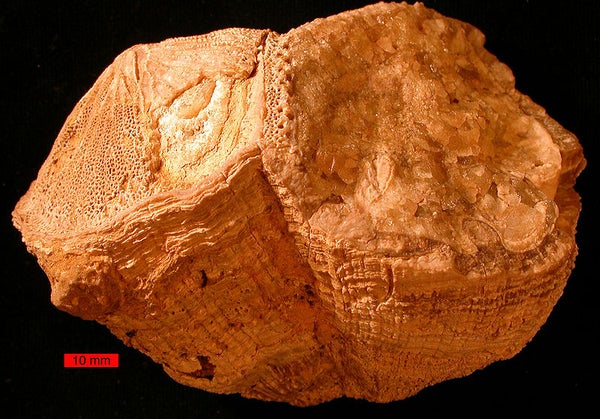
Cretaceous period rudist bivalves found in the Al-Ḥajar Mountains in the United Arab Emirates.

Illustration of a Bohr atom model spinning around the words Science Quickly with various science and medicine related icons around the text

Join Our Community of Science Lovers!


On supporting science journalism

If you're enjoying this article, consider supporting our award-winning journalism by subscribing. By purchasing a subscription you are helping to ensure the future of impactful stories about the discoveries and ideas shaping our world today.


Hi, I’m Scientific American assistant news editor Sarah Lewin Frasier. And here’s a short piece from the June 2020 issue of the magazine, in the section called Advances: Dispatches from the Frontiers of Science, Technology and Medicine. The article is titled “Quick Hits,” and it’s a rundown of some noncoronavirus stories from around the globe.

From the U.S.:

A hiker found two rusted, unexploded bombs from 1935 on the Mauna Loa volcano on Hawaii’s Big Island. The bombs had been intended to help divert lava flow during an eruption.

From France:

Researchers report dinosaur footprints up to 1.25 meters long on the roof of a cave, likely coming from a type of titanosaur. Geologic processes buried and shifted the shoreline footprints to the cave’s ceiling, 500 meters deep.

From Kenya:

A 20-year experiment revealed that cattle-grazing areas frequented by elephants store almost twice as much carbon as areas that bar the animals; soil in these areas also has higher nutrient levels.

From Germany:

In a Leipzig waste site, scientists found a soil bacterium that can break down components of polyurethane—and survive the toxic chemicals released in the process.

In Oman:

Daily growth rings on a 70-million-year-old fossilized mollusk indicate that Earth turned faster at the time, squeezing 372 days into each year. The creature’s former habitat, a shallow seabed, is now on a mountaintop.

In Australia:

Seven new peacock spider species—including one with a van Gogh Starry Night–like design—were discovered among crowd-sourced photographs from across the continent. The spiders are known for their vividly colored abdomens.

That was “Quick Hits.” I’m Sarah Lewin Frasier.

Sarah Lewin Frasier is a senior editor at Scientific American. She plans, assigns and edits the Advances section of the monthly magazine, as well as editing online news, and she launched Scientific American’s Games section in 2024. Before joining Scientific American in 2019, she chronicled humanity’s journey to the stars as associate editor at Space.com. (And even earlier, she was a print intern at Scientific American.) Frasier holds an A.B. in mathematics from Brown University and an M.A. in journalism from New York University’s Science, Health and Environmental Reporting Program. She enjoys musical theater and mathematical paper craft.

More by Sarah Lewin Frasier

It’s Time to Stand Up for Science

If you enjoyed this article, I’d like to ask for your support. Scientific American has served as an advocate for science and industry for 180 years, and right now may be the most critical moment in that two-century history.

I’ve been a Scientific American subscriber since I was 12 years old, and it helped shape the way I look at the world. SciAm always educates and delights me, and inspires a sense of awe for our vast, beautiful universe. I hope it does that for you, too.

If you subscribe to Scientific American, you help ensure that our coverage is centered on meaningful research and discovery; that we have the resources to report on the decisions that threaten labs across the U.S.; and that we support both budding and working scientists at a time when the value of science itself too often goes unrecognized.

In return, you get essential news, captivating podcasts, brilliant infographics, can't-miss newsletters, must-watch videos, challenging games, and the science world's best writing and reporting. You can even gift someone a subscription.

There has never been a more important time for us to stand up and show why science matters. I hope you’ll support us in that mission.

Thank you,

David M. Ewalt, Editor in Chief, Scientific American

Subscribe