Science News Briefs from around the Planet

Here are some brief reports about science and technology from around the world, including one from Panama about the toll lightning takes on tropical trees.

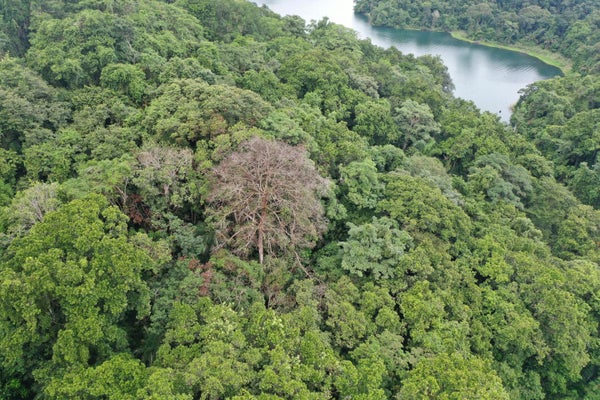
Dead tree towering over this forest stand on Barro Colorado Island in Panama was struck by lightning. The strike also killed or damaged many smaller neighbors

Illustration of a Bohr atom model spinning around the words Science Quickly with various science and medicine related icons around the text

Join Our Community of Science Lovers!

I’m Scientific American assistant news editor Sarah Lewin Frasier. And here’s a short piece from the December 2020 issue of the magazine, in the section called Advances: Dispatches from the Frontiers of Science, Technology and Medicine.

The article is titled “Quick Hits,” and it’s a rundown of some noncoronavirus stories from around the globe.

U.S.:
Western Joshua trees will get a year of temporary endangered species status in California while the state considers permanently listing the distinctive succulents as the first-ever plant species protected because of climate change–related threat.


On supporting science journalism

If you're enjoying this article, consider supporting our award-winning journalism by subscribing. By purchasing a subscription you are helping to ensure the future of impactful stories about the discoveries and ideas shaping our world today.


Panama:
A tropical forest ground survey revealed that one lightning strike often damages more than 20 trees, a quarter of which can die within a year. Researchers combined this finding with satellite data to estimate that lightning kills 200 million tropical trees worldwide every year—a significant cause of their demise.

Greenland:
Climate researchers discovered records of an automatic weather station that measured −93.3 degrees Fahrenheit one day in December 1991—a temperature colder than the average on Mars and the coldest ever recorded in the Northern Hemisphere.

Italy:
Scientists have examined a shark found south of Sardinia that somehow survived to three years old without skin or teeth. They concluded it was a genetic mutation and plan to check nearby sediment for potential pollutant causes.

China:
Newly discovered and pristinely preserved fossils suggest two sleeping dinosaurs were buried alive in an underground burrow 125 million years ago. The burrow may have collapsed under volcanic debris.

Australia:
A new study shows how Australian grasslands’ strange barren patches—called fairy circles—are landscaped by the grasses themselves. Baking heat creates a hard clay crust over a patch of ground; water runs off of it, forming a more welcoming zone at its edges that grasses bolster as they grow and cool the soil.

That was “Quick Hits.” I’m Sarah Lewin Frasier.

[The above text is a transcript of this podcast.]

Sarah Lewin Frasier is a senior editor at Scientific American. She plans, assigns and edits the Advances section of the monthly magazine, as well as editing online news, and she launched Scientific American’s Games section in 2024. Before joining Scientific American in 2019, she chronicled humanity’s journey to the stars as associate editor at Space.com. (And even earlier, she was a print intern at Scientific American.) Frasier holds an A.B. in mathematics from Brown University and an M.A. in journalism from New York University’s Science, Health and Environmental Reporting Program. She enjoys musical theater and mathematical paper craft.

More by Sarah Lewin Frasier

It’s Time to Stand Up for Science

If you enjoyed this article, I’d like to ask for your support. Scientific American has served as an advocate for science and industry for 180 years, and right now may be the most critical moment in that two-century history.

I’ve been a Scientific American subscriber since I was 12 years old, and it helped shape the way I look at the world. SciAm always educates and delights me, and inspires a sense of awe for our vast, beautiful universe. I hope it does that for you, too.

If you subscribe to Scientific American, you help ensure that our coverage is centered on meaningful research and discovery; that we have the resources to report on the decisions that threaten labs across the U.S.; and that we support both budding and working scientists at a time when the value of science itself too often goes unrecognized.

In return, you get essential news, captivating podcasts, brilliant infographics, can't-miss newsletters, must-watch videos, challenging games, and the science world's best writing and reporting. You can even gift someone a subscription.

There has never been a more important time for us to stand up and show why science matters. I hope you’ll support us in that mission.

Thank you,

David M. Ewalt, Editor in Chief, Scientific American

Subscribe