Science News Briefs from around the World

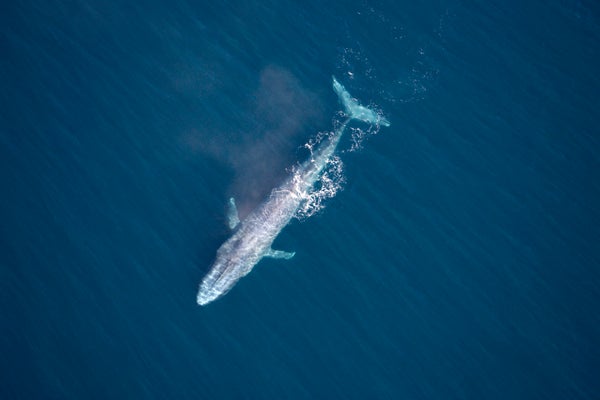
Here are a few brief reports about science and technology from around the world, including one from off the California coast about the first heart rate measurement done on a blue whale.

Illustration of a Bohr atom model spinning around the words Science Quickly with various science and medicine related icons around the text

Join Our Community of Science Lovers!

Hi, I’m Scientific American podcast editor Steve Mirsky. And here’s a short piece from the February 2020 issue of the magazine, in the section called Advances: Dispatches from the Frontiers of Science, Technology and Medicine.

The article is titled “Quick Hits,” and it’s a rundown of some science and technology stories from around the globe, compiled by assistant news editor Sarah Lewin Frasier.

From the U.S.:
Off the California coast, scientists measured a blue whale’s heart rate for the first time, using a device attached to the animal's skin by suction cup. The heart, likely weighing hundreds of pounds, beats from two to 37 times per minute, varying dramatically between diving, feeding and surfacing.


On supporting science journalism

If you're enjoying this article, consider supporting our award-winning journalism by subscribing. By purchasing a subscription you are helping to ensure the future of impactful stories about the discoveries and ideas shaping our world today.


From Peru:
Researchers analyzing satellite and imaging data have found 143 new Nazca lines—large line drawings of humans, animals and symbols etched into the Peruvian landscape millennia ago. They include a humanoid figure 16 feet across, spotted by IBM’s Watson AI system.

From Brazil:
Despite the long dry spells in Brazil’s Caatinga region, scientists found the tree Hymenaea cangaceira drizzles copious nectar from flowers to attract pollinating bats; a full-size tree can release 240 gallons of the stuff, with 38 distinct scent compounds, over a single dry season.

From Norway:
Archaeologists’ ground-piercing radar found a Viking-era ship, surrounded by a filled ditch, lurking below the soil of a western Norway farm. It was once within a burial mound.

From Jordan:
Researchers uncovered a two-horned figure in early Islamic ruins that may be the earliest chess piece ever found. The roughly 1,300-year-old object matches a rook found in an Iranian chess set from about 400 years later.

From Ethiopia:
Microbes thrive in many of Earth’s harshest environments, but researchers found no life at all in briny, scorching, acidic pools near Ethiopia’s Dallol volcano. Knowing boundaries for life’s adaptation helps to narrow the search for Earth-like life on other planets.

That was “Quick Hits,” by Sarah Lewin Frasier.

Sarah Lewin Frasier is a senior editor at Scientific American. She plans, assigns and edits the Advances section of the monthly magazine, as well as editing online news, and she launched Scientific American’s Games section in 2024. Before joining Scientific American in 2019, she chronicled humanity’s journey to the stars as associate editor at Space.com. (And even earlier, she was a print intern at Scientific American.) Frasier holds an A.B. in mathematics from Brown University and an M.A. in journalism from New York University’s Science, Health and Environmental Reporting Program. She enjoys musical theater and mathematical paper craft.

More by Sarah Lewin Frasier

It’s Time to Stand Up for Science

If you enjoyed this article, I’d like to ask for your support. Scientific American has served as an advocate for science and industry for 180 years, and right now may be the most critical moment in that two-century history.

I’ve been a Scientific American subscriber since I was 12 years old, and it helped shape the way I look at the world. SciAm always educates and delights me, and inspires a sense of awe for our vast, beautiful universe. I hope it does that for you, too.

If you subscribe to Scientific American, you help ensure that our coverage is centered on meaningful research and discovery; that we have the resources to report on the decisions that threaten labs across the U.S.; and that we support both budding and working scientists at a time when the value of science itself too often goes unrecognized.

In return, you get essential news, captivating podcasts, brilliant infographics, can't-miss newsletters, must-watch videos, challenging games, and the science world's best writing and reporting. You can even gift someone a subscription.

There has never been a more important time for us to stand up and show why science matters. I hope you’ll support us in that mission.

Thank you,

David M. Ewalt, Editor in Chief, Scientific American

Subscribe