

Predators like wolves affect their ecosystems by eating their prey. But a more subtle impact involves fear. Predators also terrify prey species. And when, for example, elk are hiding, they don't spend as much time eating leaves. The impact of a predator down through the food web all the way to plants is called a "trophic cascade."
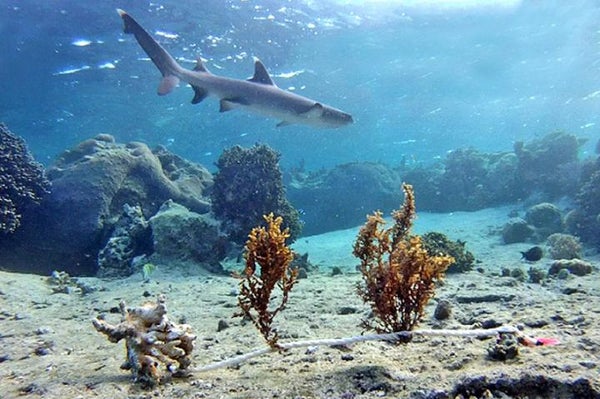
Meanwhile, fish at a coral reef near the Fiji archipelago in the South Pacific generally graze on the seaweeds that grow on the reef. But when reef sharks emerge from deeper waters, it's best to quit foraging and hide instead.
"Thinking about these other ecosystems, like wolves, their effects in their ecosystems don't play out in all places in all times. They happen to be most pronounced in risky habitats, like river valleys or gorges.”
On supporting science journalism
If you're enjoying this article, consider supporting our award-winning journalism by subscribing. By purchasing a subscription you are helping to ensure the future of impactful stories about the discoveries and ideas shaping our world today.
Marine scientist Douglas Rasher, from the nonprofit Bigelow Laboratory for Ocean Sciences in Maine.
“So it got me thinking that maybe these shallow habitats might be the place where sharks have their most pronounced effects on the ecosystem."
At one time, researchers did not even think trophic cascades even existed in the real world, and many still debate whether sharks can drive trophic cascades on coral reefs. By observing reef communities in Fiji's Votua Marine Reserve, Rasher and his team discovered that sharks do in fact influence plant growth on the reefs—by scaring the herbivorous fish away from eating them.
Here's how it works: when the tide rises, sharks make hunting raids into the shallow lagoons. The fish stop eating and hide instead. But during low tide, the predators are isolated in deeper waters, unable to access the reef-enclosed lagoons. That's when the fish can safely graze.
"All the fish in this system have a very keen sense of when the tide is coming up and when the tide is going out. If you just sort of sit there and watch through the transition, you see, particularly with the large herbivores, as the tide starts to drop they seem to know it, and they jet. And it's really predictable."
The upshot is that the deeper parts of the reef are more extensively grazed, while seaweed grows more freely on the higher parts of the reef that are accessible to the fish only when they are focused on avoiding becoming a shark's lunch. The results are in the journal Scientific Reports. [Douglas B. Rasher, Andrew S. Hoey and Mark E. Hay, Cascading predator effects in a Fijian coral reef system.]
For Rasher, these findings mean that the question is no longer whether sharks influence the dynamics of reef plant and animal communities, but instead under what conditions they do so.
"Predators can have important impacts on coral reefs, but we need to look carefully to determine when and where those important impacts exist."
—Jason G. Goldman
[The above text is a transcript of this podcast.]
