
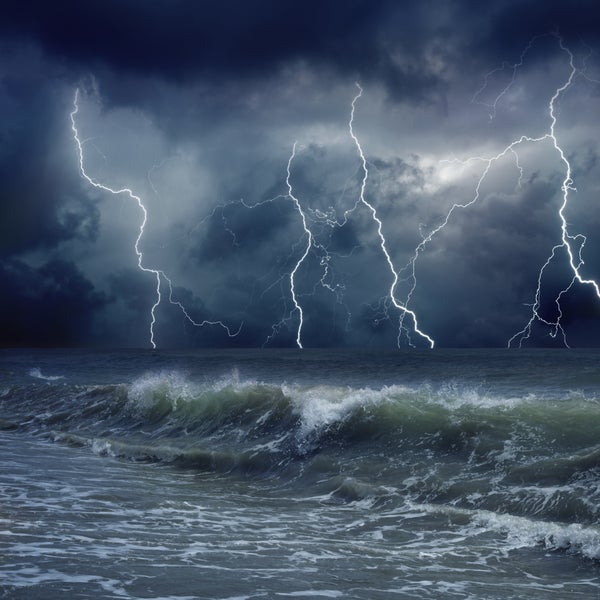

When lightning sparks across the sky, it sends out low-frequency radio waves that researchers can use to determine its location. Recently, scientists were looking over a map of lightning activity, when they noticed something strange: narrow lines of increased lightning frequency stretching across the Indian Ocean and the South China Sea. Straight features like these are rare on a spherical, spinning planet, except where humans are up to something. In this case, sending ships across the sea.
“I had pretty immediately in my mind postulated that this was a result of the pollution from ship exhaust influencing the way the storms develop.”
Joel Thornton, an atmospheric chemist at the University of Washington.
On supporting science journalism
If you're enjoying this article, consider supporting our award-winning journalism by subscribing. By purchasing a subscription you are helping to ensure the future of impactful stories about the discoveries and ideas shaping our world today.
“That hypothesis had already been put out generally in the field more than a decade ago. But we had been lacking clear evidence that this was happening on a large-scale, long-time horizon.”
The new maps changed that. Thornton and his team found that, on average, lightning activity almost doubled over shipping lanes compared to adjacent areas of the ocean.
The researchers ruled out natural explanations for the pattern, and concluded it must be related to ship exhaust. Exhaust increases the number of tiny particles in the air, on which water vapor condenses to form cloud droplets. Spreading the same amount of water over more particles leads to smaller droplets, which get lifted by updrafts until they reach altitudes cold enough for them to freeze. For reasons scientists still don’t fully understand, interactions between these ice particles and water droplets inside the cloud builds up electrical charges—and produce lightning.
Thornton says the ship tracks provide a unique opportunity to isolate the effects of pollution from all the other factors normally at play in storms.
“From a science standpoint it’s exciting that we have this ongoing experiment where we know roughly how much particle pollution is being put into the atmosphere, we have a good signature that it’s influencing the nature of storms, and then we can use this experiment as a way to improve our understanding of how pollution affects the development of storms and their intensity.”
The research was published in the journal Geophysical Research Letters. [Joel A. Thornton et al., Lightning enhancement over major oceanic shipping lanes]
The International Maritime Organization recently adopted a rule that will force ships to start using fuels with lower sulfur content. That change will help reduce particle pollution—and should provide Thornton with new data.
“So, if they all do it at the same time in 2020, or even if they stagger it in over the period of a few years, the lightning response should be essentially immediate.”
The cleaner fuel standards will help the environment, and boost lightning science, too.
—Julia Rosen
[The above text is a transcript of this podcast.]
