
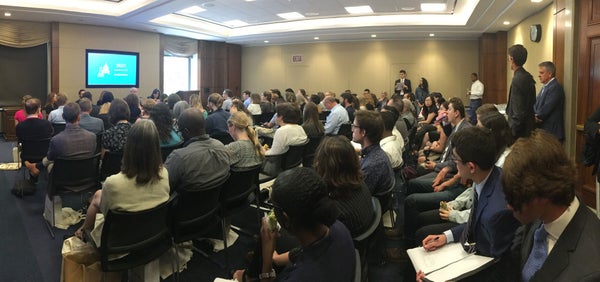

Welcome to Scientific American’s Science Talk, posted on June 19, 2019. I’m Steve Mirsky. On June 6th, Scientific American, Nature Research and California Congressman Jerry McNerney hosted our third Science on the Hill event. This edition focused on solving the problem of plastic waste. And what you’ll near now is an edited version of the hour-long panel discussion with experts and Representative McNerney, who holds a doctorate in mathematics. The event was moderated by our editor-in-chief, Mariette DiChristina, and it looked at plastics and microplastics, and offered some important info about the legendary Great Pacific Garbage Patch. Here's Mariette DiChristina.
PANEL DISCUSSION featuring Morton A. Barlaz, Distinguished University Professor and Head of the Department of Civil, Construction and Environmental Engineering at North Carolina State University; April Crow, Senior Advisor to Circulate Capital, supporting the launch of the impact-focused investment management firm dedicated to financing innovation, companies and infrastructure that prevent the flow of plastic waste into the world's ocean while advancing the circular economy; and Kara Lavender Law, Research Professor at Sea Education Association, studying the sources, distribution, behavior and fate of plastic debris in the ocean.
Podcasts of the previous two Science on the Hill events are available on our website. The June 18, 2018, episode featured a discussion of Artificial Intelligence, Robotics and Your Health. The January 29th, 2018, episode covered the future of American energy.
On supporting science journalism
If you're enjoying this article, consider supporting our award-winning journalism by subscribing. By purchasing a subscription you are helping to ensure the future of impactful stories about the discoveries and ideas shaping our world today.
That’s it for this episode. Get your science news at our website, www.scientificamerican.com, where you can read Ed Bell’s story on a 3-D-style video that gives you a new perspective on Apollo 11 on the moon 50 years ago. And you can watch that video, narrated by my friend Ed. He’s a Mets fan, so he often takes soothing mental vacations to 1969.
And follow us on Twitter, where you’ll get a tweet whenever a new item hits the website. Our twitter name is @sciam. For Scientific American’s Science Talk, I’m Steve Mirsky. Thanks for clicking on us.
