
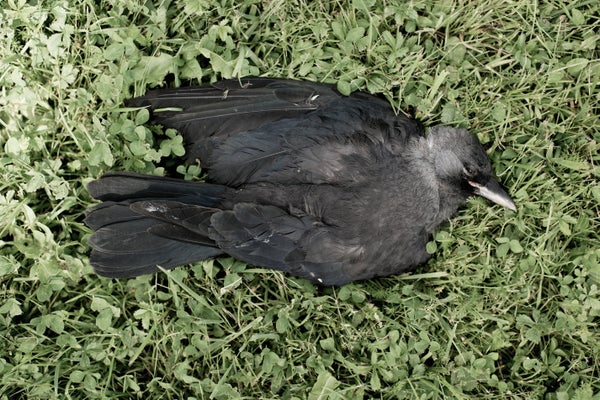

Crows react really strongly to one of their own being dead—including gathering around their deceased comrades. Some experts believe that these so-called crow funerals are efforts to learn. Perhaps so they can avoid the same fate.
University of Washington researcher Kaeli Swift is one of those crow experts. When a film crew came to her campus to record these behaviors, Swift and her colleagues placed a dead crow on the grass. And they waited for the crows to show up and investigate. Just as they had done hundreds of previous times.
"The first bird came in, like they do, and I'm bracing myself for what I'm expecting to be the typical response. Which is that it alights in a tree, and it alarm calls, and then other birds come in…but instead what it does is it flies down to the ground, and it kind of walks up to the crow…but then it goes into really typical crow precopulatory posturing. Where basically they drop their wings down, and they stick their tails up, and they strut. And it just struts on over to the dead crow and jumps on top and copulates with it."
On supporting science journalism
If you're enjoying this article, consider supporting our award-winning journalism by subscribing. By purchasing a subscription you are helping to ensure the future of impactful stories about the discoveries and ideas shaping our world today.
Neither Swift nor her advisor had ever heard of this behavior. So they decided to determine just how common it is by conducting a series of experiments with wild crows in Seattle. They saw that most crows don't touch their dead—they observed physical contact roughly a quarter of the time. And sexual contact occurred less than five percent of the time. The finding is in the journal Philosophical Transactions of the Royal Society B. [Kaeli Swift & John M. Marzluff. Occurrence and variability of tactile interactions between wild American crows and dead conspecifics]
There's a twist that may be instructive: the crows' sexual behaviors were often combined with aggressive ones—not something that usually happens during mating encounters. And this was most frequent early in the breeding season. The researchers therefore wonder if some extremely hormonal crows may be unable to suppress one set of behaviors while expressing the other.
"Maybe these birds, because of these hormonal influences, are so incredibly territorial, they're so quick to take advantage of any opportunity for an extra-pair copulation, which is something we know crows engage in…but the part about this that makes it so exciting is we were actually able to quantify how frequent this behavior is. And that's completely brand new to science in any vertebrate animal."
—Jason G. Goldman
[The above text is a transcript of this podcast.]
