
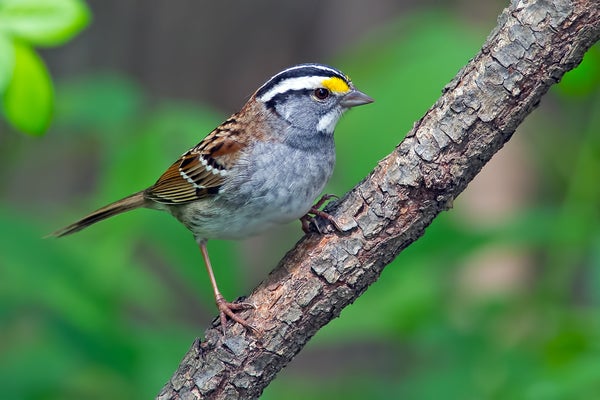

Like many birds, male white-throated sparrows belt out songs to defend their territories and attract mates. And until the year 2000, one particular song stood out as the most popular white-throat tune in forests across Canada.
[CLIP: Triplet song]
“The end part of the song is a three-syllable repeat. That’s supposed to sound like ‘Oh my sweet Canada, Canada, Canada.’”
On supporting science journalism
If you're enjoying this article, consider supporting our award-winning journalism by subscribing. By purchasing a subscription you are helping to ensure the future of impactful stories about the discoveries and ideas shaping our world today.
University of Northern British Columbia behavioral ecologist Ken Otter.
“And if you look in most books that describe what the song sounds like, it always has a three-syllable phrase at the end of it.”
But when Otter moved to Prince George, a wooded city in western Canada, 20 years ago, he noticed that its sparrows were singing a different tune.
“The males have dropped one of the notes, so instead of having three syllables repeating, it’s actually two syllables repeating ...”
[CLIP: Doublet song]
“‘Oh my sweet Cana, Cana, Canada.’”
Back in the 1950s, though, the Prince George population was still singing the standard triplet song.
“So sometime during that 50-year period, the song had transitioned to this new dialect, and all the males had adopted it.”
Over the next few years, Otter’s team discovered that the doublet song variant was spreading eastward.
“And it’s replacing the old song as it goes.”
By 2010 the song had invaded Ontario, thousands of kilometers from Prince George. Once it became popular, it began to spread even faster.
“And right now it has moved all the way across Eastern Ontario and is kind of bordering Quebec.”
Otter was surprised by the rapid, widespread adoption of the doublet song, because most new bird song dialects don’t travel far.
“It’s very much at odds with a lot of the traditional ideas that we have about how dialects form and how they persist over time.”
The doublet song likely owes its spread to the birds’ migration habits. Tracking sparrows from western Canada revealed that they intermingle with eastern birds on their wintering grounds in the southern Great Plains. Those eastern birds probably learn the new dialect there and then bring it back home.
The study is in the journal Current Biology. [Ken A. Otter et al., Continent-wide shifts in song dialects of white-throated sparrows]
It’s not yet known what advantages singing the doublet song offers. So far, there’s no evidence that the males react differently to the two variants when defending their territories. But the researchers also plan to test whether the new dialect’s popularity is driven by a female preference for novelty. One thing’s for sure: we aren’t the only species that can make a tweet go viral.
—Susanne Bard
[The above text is a transcript of this podcast.]
Credit: White-throated sparrow recordings by Ken A. Otter and Scott M. Ramsay.
Volunteers are needed to document how these song dialects are still changing today. Find out how you can help at www.whitethroatsong.ca.
