
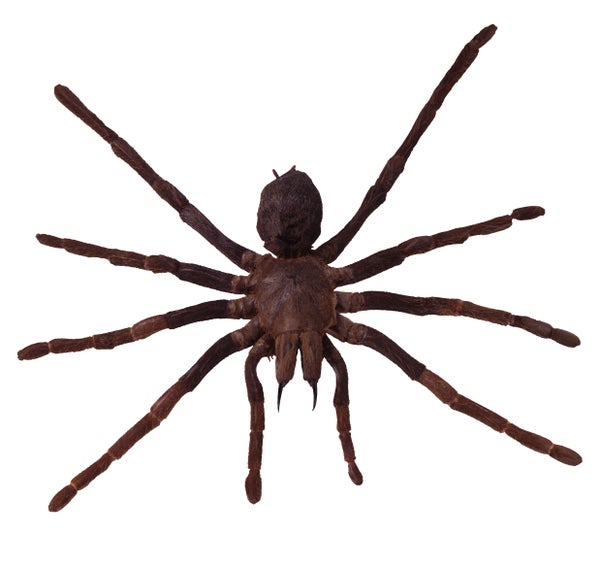

By now, you may have heard about a study that came out a couple of weeks ago about spiders. The study got a lot of attention because coverage of the research often focused on the idea that spiders could eat every single person on the planet in a year and still find room for a lot of cows and elephants and such. In other words, spiders need a lot of meat. Fortunately, the food of choice for the overwhelming majority of spiders is other arthropods, mostly insects and another type of tiny critter called springtails.
Anyway, the study—which never mentions spiders eating all the world’s people—was done by Martin Nyffeler at the University of Basil in Switzerland and Klaus Birkhofer of Lund University and Germany’s Brandenburg University of Technology. [Martin Nyffeler and Klaus Birkhofer, An estimated 400–800 million tons of prey are annually killed by the global spider community]
Places with plenty of spiders. Because most places are places with plenty of spiders. The write-up the April issue of the journal The Science of Nature concluded that the world’s spider population weighs some 25 million tons. Now, your average spider only weighs an itty-bit, so if you do the calculation you get a total worldwide population of some eleventy gazillion spiders. More or less. But the 25 million tons of spiders is a real number, derived from other published studies, dating as far back as 1951.
On supporting science journalism
If you're enjoying this article, consider supporting our award-winning journalism by subscribing. By purchasing a subscription you are helping to ensure the future of impactful stories about the discoveries and ideas shaping our world today.
The researchers then estimated how much weight in food that much weight of spiders would need. And they also went through many other studies that had estimated how much spiders ate in particular habitats, ranging from tropical forests to farms. Once they crunched all those arthropods, the intrepid spider speculators reached their verdict: spiders snatch between 400 million and 800 million tons of meat annually.
So if you see a spider—and there’s almost certainly a bunch in your home right now—you could stomp it. Or you could gently put it outside. Or you could wish itbon appétit! Andleave it to dine on the other stuff you probably want in your home even less.
—Steve Mirsky
[The above text is a transcript of this podcast.]
