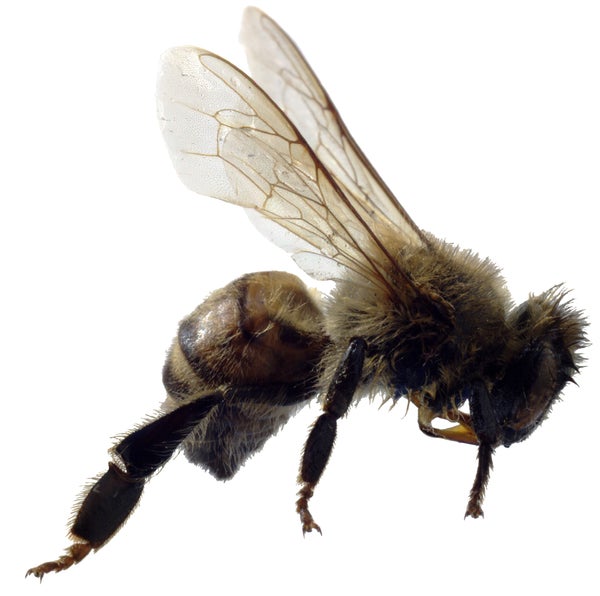
Stone Age Pottery Reveals Signs of Beekeeping

Beeswax residues found on shards of stone age pottery in the Mediterranean region indicate that humans were keeping honeybees as early as 9,000 years ago


Getty (MARS)

Illustration of a Bohr atom model spinning around the words Science Quickly with various science and medicine related icons around the text

Join Our Community of Science Lovers!

You have bees to thank every time you drizzle some honey into your tea. And the human-honeybee relationship is long-standing. Iconography of honeybees adorns 4400-year-old walls in ancient Egypt. Rock art has been found that depicts a stone age bee harvest. But exactly when early farmers began to exploit bees has been unclear.

Those farmers exploited bees for more than honey. Research has shown that they also employed the beeswax for cosmetics, fuel, medicine, and to perform rituals.

Beeswax contains complex fats that leave a recognizable residue on pottery and other archaeological artifacts. And scientists have now used that beeswax residue to analyze what they’ve determined to be the earliest known human-and-bee association, dating back some 9,000 years.


On supporting science journalism

If you're enjoying this article, consider supporting our award-winning journalism by subscribing. By purchasing a subscription you are helping to ensure the future of impactful stories about the discoveries and ideas shaping our world today.


The researchers surveyed Europe, the Near East and northern Africa. They found beeswax on pottery vessels from Neolithic farming sites in Anatolia, in or near modern-day Turkey. They also discovered the first evidence of beeswax at Neolithic sites in Northern Africa. And the lack of wax residues in Ireland, Scotland and the Scandanavian peninsula led them to conclude that those locations were above what must have been a northern limit for honeybees. The study is in the journal Nature. [Mélanie Roffet-Salque et al, Widespread exploitation of the honeybee by early Neolithic farmers]

The researchers say that the beeswax residues at these human-occupied sites may be clues pointing to the very beginnings of bee domestication. With thousands of years of sweet results for us all.

—Cynthia Graber

[The above text is a transcript of this podcast.]

[Scientific American is part of Nature Publishing Group.]

Cynthia Graber is a print and radio journalist who covers science, technology, agriculture, and any other stories in the U.S. or abroad that catch her fancy. She's won a number of national awards for her radio documentaries, including the AAAS Kavli Science Journalism Award, and is the co-host of the food science podcast Gastropod. She was a Knight Science Journalism fellow at MIT.

More by Cynthia Graber

It’s Time to Stand Up for Science

If you enjoyed this article, I’d like to ask for your support. Scientific American has served as an advocate for science and industry for 180 years, and right now may be the most critical moment in that two-century history.

I’ve been a Scientific American subscriber since I was 12 years old, and it helped shape the way I look at the world. SciAm always educates and delights me, and inspires a sense of awe for our vast, beautiful universe. I hope it does that for you, too.

If you subscribe to Scientific American, you help ensure that our coverage is centered on meaningful research and discovery; that we have the resources to report on the decisions that threaten labs across the U.S.; and that we support both budding and working scientists at a time when the value of science itself too often goes unrecognized.

In return, you get essential news, captivating podcasts, brilliant infographics, can't-miss newsletters, must-watch videos, challenging games, and the science world's best writing and reporting. You can even gift someone a subscription.

There has never been a more important time for us to stand up and show why science matters. I hope you’ll support us in that mission.

Thank you,

David M. Ewalt, Editor in Chief, Scientific American

Subscribe