
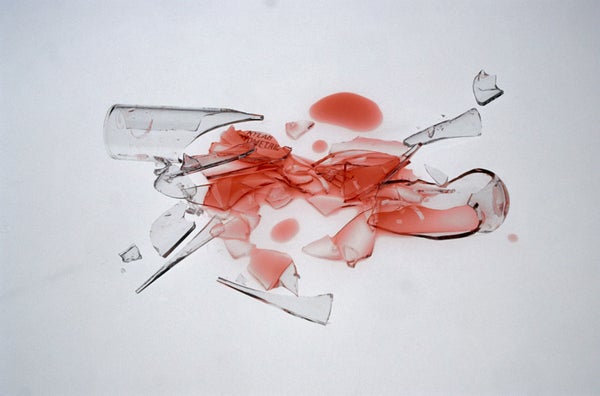

When you spill a liquid on the ground, it splashes. But if you’re a guy using a urinal, or, more important, if the liquid is dangerous, say, an infected blood sample, you want to limit splashing. In other words:
“If an accident happens, you want the drop to fall onto the surface and that’s it. It just stays there as a single body.”
Alfonso Castrejón-Pita, an engineering professor at Oxford University.
On supporting science journalism
If you're enjoying this article, consider supporting our award-winning journalism by subscribing. By purchasing a subscription you are helping to ensure the future of impactful stories about the discoveries and ideas shaping our world today.
“So you could imagine the situation of having your [lab] bench covered with these kinds of materials so they become safer. And the same for a kitchen. Now you’re in a kitchen, you are handling raw chicken, and the last thing you want is to have splashes, where you could be transmitting salmonella or these kinds of ugly things that you could get when you are handling raw meat.”
He and his colleagues found that the softer the surface the smaller the splash. Their study is in the journal Physical Review Letters. [Christopher J. Howland et al., It’s Harder to Splash on Soft Solids]
The researchers prepared a bunch of increasingly squishy silicone surfaces and released drops of ethanol onto them from different heights. They captured video of the splashes with a super-slow-motion camera that records more than 100,000 frames per second. And they found that the drops eventually stopped splashing on the softest surfaces.
So far that all sounds predictable. But computer models of the splashes revealed interesting details.
At the moment the blob of liquid makes contact with the surface, the bottom of the drop flattens out and the pressure increases. The ring of pressure spreads towards the drop’s edges. If the surface is too hard, the ring of high pressure creates tiny droplets that explode from the main drop’s edges. But the softest surfaces deform in response to the drop hitting them—and that prevents the pressure from getting high enough to cause that explosion.
Sadly, you won’t see squishy coatings on urinals just yet, or in your laboratories—anti-splash materials are too frail.
“The softest ones are quite delicate so you wouldn’t be able to make a laboratory bench with them, they’d get damaged quite quickly.”
So we’d need soft coating materials robust enough to withstand daily wear before the splash is relegated to history’s trash bin…or toilet.
—Ryan Mandelbaum
[The above text is a transcript of this podcast.]
