
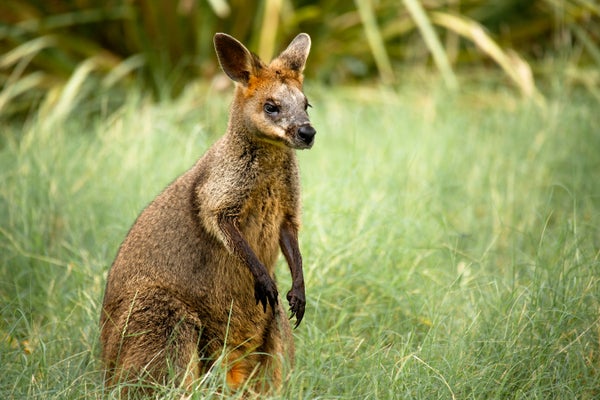

Picture a small kangaroo. You’re basically seeing something very much like the Australian marsupial called the swamp wallaby. They’re also known as black stinkers because of their distinctive odor.
“I can’t really describe it except to say it’s quite a pungent smell. It’s not terribly pleasant.”
University of Melbourne biologist Marilyn Renfree, who says that their unique scent isn’t the only thing that sets swamp wallabies apart from their evolutionary relatives. She and her colleagues recently discovered that adult female swamp wallabies can carry two pregnancies—in different stages of development—at the same time. That’s possible because—like other kangaroos and wallabies—they have not just one uterus but two. But unlike their close relatives, pregnant swamp wallabies mate again a day or two before they give birth.
On supporting science journalism
If you're enjoying this article, consider supporting our award-winning journalism by subscribing. By purchasing a subscription you are helping to ensure the future of impactful stories about the discoveries and ideas shaping our world today.
“We only know that strategy in one other mammal, and that’s the European hare. And the European hare does this mating while they’re pregnant—a phenomenon known as superfetation. So they”—the wallabies—“have effectively a fetus at an advanced stage of pregnancy and a very, very early conceptus at the same time.”
Renfree and her team confirmed the simultaneous pregnancies using high-resolution ultrasound.
“And so, for the first time we were able to actually prove that the swamp wallaby is pregnant its whole life. It's never not pregnant.”
This revolving cycle of pregnancy means that after a female swamp wallaby gives birth to her first baby from one uterus, a second embryo lies dormant in her other uterus, while the first baby attaches to a teat within her pouch. After nine months, the first baby leaves the pouch, triggering the second embryo to start developing. And right before the second baby is born, the mother mates again, and a third embryo is implanted back in the first uterus.
What’s more, while the second baby lives inside the mother’s pouch, the first baby hops around outside, continuing to suckle from a teat in her pouch. But she’s able to supply each of them with milk tailored to their specific developmental needs.
“The little baby is drinking a milk of a totally different composition.”
And once this second baby leaves the pouch, the third embryo starts to develop, and the cycle continues.
“So the swamp wallaby has it all. It has a continuous pregnancy and a continuous lactation for most of its life. Truly amazing animal.”
The study is in the Proceedings of the National Academy of Sciences. [Brandon R. Menzies et al., Unique reproductive strategy in the swamp wallaby]
Whatever evolutionary benefit exists to the swamp wallaby’s unusual reproductive strategy remains to be seen. After all, being pregnant all the time isn’t exactly a hop in the park.
—Susanne Bard
[The above text is a transcript of this podcast.]
