Sweet Song Gives Away New Bird Species

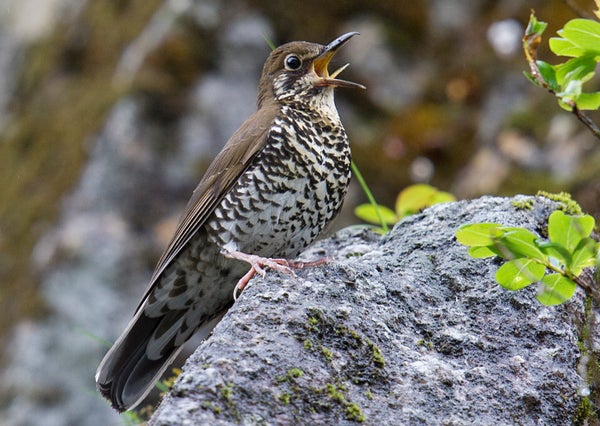
The newly discovered Himalayan forest thrush looks a great deal like the alpine thrush, but its far silkier song stylings gave it away as a potential new species.


Himalayan Forest Thrush Zoothera salimalii, Dulongjiang, Yunnan province, China, June 2014

Craig Brelsford (www. www.shanghaibirding.com) via Wildlife Conservation Society

Illustration of a Bohr atom model spinning around the words Science Quickly with various science and medicine related icons around the text

Join Our Community of Science Lovers!

[Bird song]

That, of course, is the sound of the Himalayan forest thrush. And that sound was a clue to field researchers that they might have a new species of bird on their hands. Even though it was in the bush. You know what I mean.
 

You see, the Himalayan forest thrush looks a great deal like another well-known bird called the alpine thrush. They’re both found in northeastern India and nearby parts of China. But the alpine thrush has a raspy song compared with the more mellifluous Himalayan forest thrush.


On supporting science journalism

If you're enjoying this article, consider supporting our award-winning journalism by subscribing. By purchasing a subscription you are helping to ensure the future of impactful stories about the discoveries and ideas shaping our world today.


One of the researchers, Shashank Dalvi of India’s National Centre for Biological Sciences and the Wildlife Conservation Society, likened the two different birds to Rod Stewart versus Adele.
 

Further analyses, including of the birds’ DNA, confirmed that the song differences were indicative of these birds indeed belonging to two separate species. The finding is in the journal Avian Research. [Per Alström et al, Integrative taxonomy of the Plain-backed Thrush (Zoothera mollissima) complex (Aves, Turdidae) reveals cryptic species, including a new species]
 

The discovery of a new bird species is relatively rare. Since the year 2000, ornithologists have found five new species annually on average, mostly in South America. So this newly characterized thrush—only the fourth new species found in India since it became independent in 1947—should send birdwatchers from all over the world flocking. I mean, it’s a sound discovery.
 

—Steve Mirsky


[The above text is a transcript of this podcast.]
 

[Bird songs recorded by Per Alström]

It’s Time to Stand Up for Science

If you enjoyed this article, I’d like to ask for your support. Scientific American has served as an advocate for science and industry for 180 years, and right now may be the most critical moment in that two-century history.

I’ve been a Scientific American subscriber since I was 12 years old, and it helped shape the way I look at the world. SciAm always educates and delights me, and inspires a sense of awe for our vast, beautiful universe. I hope it does that for you, too.

If you subscribe to Scientific American, you help ensure that our coverage is centered on meaningful research and discovery; that we have the resources to report on the decisions that threaten labs across the U.S.; and that we support both budding and working scientists at a time when the value of science itself too often goes unrecognized.

In return, you get essential news, captivating podcasts, brilliant infographics, can't-miss newsletters, must-watch videos, challenging games, and the science world's best writing and reporting. You can even gift someone a subscription.

There has never been a more important time for us to stand up and show why science matters. I hope you’ll support us in that mission.

Thank you,

David M. Ewalt, Editor in Chief, Scientific American

Subscribe