
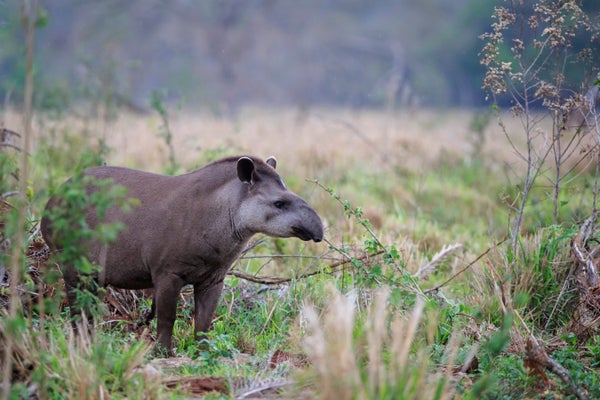

The Amazon rain forest is under threat. Fragmentation, fires and climate change are just a few of the hazards. In natural, intact forests, animals that eat fruits help to keep the forest in a constant state of regeneration since they deposit seeds in their droppings as they travel. Could the same process help restore areas degraded by fire?
“There are a lot of tapirs walking around the study area. And they, of course, poop a lot, because they are huge herbivores.”
Lucas Paolucci from Brazil’s Amazon Environmental Research Institute.
On supporting science journalism
If you're enjoying this article, consider supporting our award-winning journalism by subscribing. By purchasing a subscription you are helping to ensure the future of impactful stories about the discoveries and ideas shaping our world today.
“So our team asked whether they could be walking around and eventually helping to reforest this area through their poops and, of course, the seeds that are within it.”
Tapirs are the largest terrestrial mammals left in the Amazon rain forest. Imagine a 500-pound pig but with a small elephant trunk on its face—that’s sort of what a lowland tapir looks like. The species is threatened with extinction, but certain areas still have quite a few tapirs roaming around.
Using a combination of camera traps, aerial imagery and field observations, the researchers measured the density and abundance of tapir droppings in three different parts of the rain forest over the course of seven years. One test plot was experimentally burned each year, one was burned every three years, and one was left completely intact.
“We saw that tapirs were occurring two times more often in disturbed areas than the unburned plots and also dispersing three times more seeds.”
That’s a lot of seeds. Extrapolating from the data, in intact forests, a single tapir deposits almost 3,000 seeds in a single hectare, or 10,000 square meters. But in burned areas, the animals drop nearly 10,000 seeds. And while researchers don’t know how many seeds can germinate after a trip through a tapir’s digestive system, fewer than one percent of such seeds appeared damaged.
But tapirs are just part of the equation. After they do a number two, dung beetles get to work forming the scat into balls before burying them, seeds included. Paolucci is now looking at whether dung beetles, like the tapir dung, are also more abundant in recently burned areas. [Lucas N. Paolucci et al., Lowland tapirs facilitate seed dispersal in degraded Amazonian forests]
Putting tapirs to work doing what they already do best is perhaps the cheapest method for large-scale tropical forest restoration. Such renewal is critical for carbon sequestration, biodiversity preservation, and much more. Tapirs alone won’t do the job alone; their work would help lower the price tag.
—Jason G. Goldman
[The above text is a transcript of this podcast.]
