
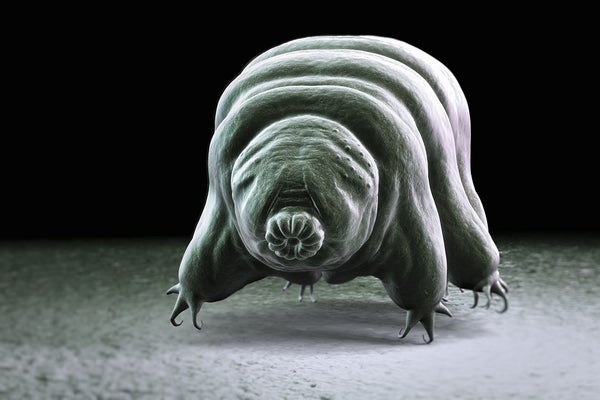

Tardigrades are some of nature’s toughest animals. Also known as water bears, the tiny creatures can withstand extreme conditions, like boiling hot temperatures, long periods of dehydration and even oxygen deprivation.
“One of the really cool things about tardigrades is that you can shoot them into outer space, and they can survive the vacuum and radiation of the low-Earth orbit.”
University of California, San Diego, biochemist Jim Kadonaga. Of course, he says tardigrades didn’t evolve to endure the perils of space travel.
On supporting science journalism
If you're enjoying this article, consider supporting our award-winning journalism by subscribing. By purchasing a subscription you are helping to ensure the future of impactful stories about the discoveries and ideas shaping our world today.
“Many tardigrades live in environments that are both wet and dry, like moss. And when it’s wet, they’re active. And when it’s dry, they can go into a desiccated state that’s something like a state of suspended animation.”
Normally, dehydration would make tardigrade DNA susceptible to damage from chemicals called hydroxyl radicals, which form when water molecules split. They also form when DNA is exposed to radiation. But Kadonaga suspected that a protein found only in tardigrades, called Dsup, might protect their DNA under both conditions. (Dsup stands for “damage suppressor protein.”)
“And the remarkable thing about this Dsup protein is that when you put it into human cells in the laboratory, it makes those cells more resistant to x-ray radiation.”
Kadonaga’s team, led by then undergraduate student Carolina Chavez, studied how Dsup protects DNA in cells. They found that it binds to chromatin, the compact structure that allows long molecules of DNA to ball up and fit into a tiny cell. The researchers think Dsup acts as a sort of chromatin insulator, shielding DNA from attack by hydroxyl radicals. They conclude that the protein is likely the key to the tardigrade’s extreme hardiness in conditions that would prove lethal to most other organisms.
The study appears in the journal eLife. [Carolina Chavez et al., The tardigrade damage suppressor protein binds to nucleosomes and protects DNA from hydroxyl radicals]
Kadonaga says understanding the tardigrade’s secret weapon may also inform biotechnology and pharmaceutical research.
“And so, now that we know how Dsup works, we might be able to use that knowledge to make designer versions of Dsup that can be used to potentially make cells more durable or longer-lived.”
—Susanne Bard
[The above text is a transcript of this podcast.]
