
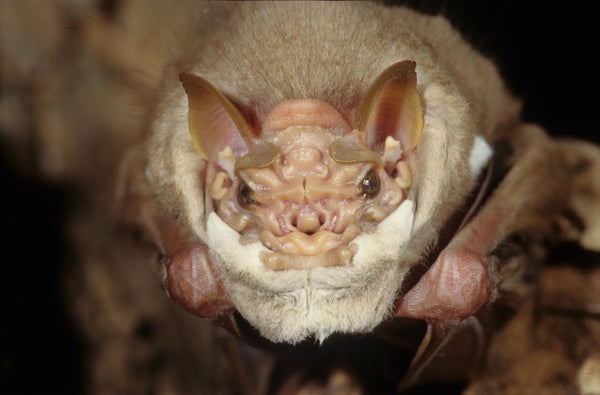

What do you call a bat that only eats fruit, but isn’t classified as one of the fruit bats? One species that fits that description is thought to live in forests from Southern Mexico to the north end of South America. But they're so rarely seen that very little is known about them, apart from their uniqueappearance—which is why the species is called the wrinkle-faced bat.
“Many people say that these bats are really ugly, but the word ugly is for bat biologists a forbidden word. So, I think we all agree that they are pretty special looking bats.”
University of Ulm researcher Marco Tschapka. His colleague Gloria Gessinger, agrees.
On supporting science journalism
If you're enjoying this article, consider supporting our award-winning journalism by subscribing. By purchasing a subscription you are helping to ensure the future of impactful stories about the discoveries and ideas shaping our world today.
(Gessinger): “Most bats look like cute little puppies, but they have a very wrinkly face and it's just a lot of wrinkles everywhere.
But something else about the males may be an even more unusual facial feature.
(Tschapka): “It's very easy to distinguish between male and female, because the males have this funny face mask.”
Using their little bat thumbs, males can pull up a furry flap of skin to cover their faces like a mask.
(Tschapka): “The bat almost tries to hide its entire face inside of the mask. And people have suspected for a long time that these masks have something to do with matings.”
But the bats' courtship is difficult to study because they are so hard to find. That is, until 2018, when Tschapka and Gessinger's colleague, University of Costa Rica biologist Bernal Rodríguez-Herrera, received a tip that a group of males had been spotted in a highland forest. His team rushed there to record their behaviors using infrared video cameras and specialized microphones.
(Tschapka): “The objective was that we get as much information as possible about these animals. And the bats stayed there for something like six weeks.”
The animals formed what's called a lek, where a group of males hangs out in a small area, displaying extravagantly to females—an uncommon reproductive strategy in bats. The males start their display by rubbing their fingers together for hours.
(Tschapka): “Which looks really weird.”
Eventually, they begin to sing, even with their faces covered.
(Gessinger): “And they do these trills and echolocation calls on their perches. The trill sounds something like this: “brrrrr”.
(clip: trill)
(Gessinger): “…and then the echolocation calls in between, and then trills again.”
(clip: echolocation and trill)
The ultrasound recordings have been slowed down to be in the range of human hearing.
(Gessinger): “Sometimes they put the mask down and up again, and then they continue singing.”
But if another bat approaches, they start making noise with their wings.
(clip: wing beats)
(Gessinger): “…followed by this super-loud whistle sequence.”
(clip: loud whistle)
After a sequence of sounds, the researchers documented one mating between a male and a female. They think the raised mask and sounds, along with odor cues, may play an important role in the wrinkle-faced bats’ courtship.
The study is in the journal PLOS ONE. [Bernal Rodríguez-Herrera, et al., The masked seducers: Lek courtship behavior in the wrinkle-faced bat Centurio senex (Phyllostomidae)]
Many questions remain. So researchers returned to the site a year later in hopes of learning more about the elusive bats' courtship behaviors. But the bats were nowhere to be found.
(Tschapka): “So you really need to have a lot of luck to learn more about this.”
—Susanne Bard
(The above text is a transcript of this podcast)
Bat recordings courtesy of Bernal Rodríguez-Herrera et al.
