
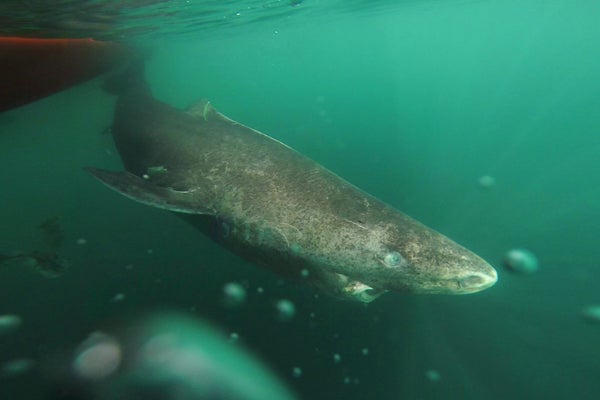

By human standards, a few vertebrate species have incredible longevity. Some tortoises live for nearly 200 years. Bowhead whales can live even a decade or two longer. But now there’s a new champion: the Greenland shark—which conservative estimates have swimming in the seas for almost three centuries.
Julius Nielsen is a marine biologist and PhD student at the University of Copenhagen. While on a research vessel in Greenland where such sharks were accidentally caught, Nielsen became curious about the creatures.
“And perhaps the biggest of all the mysteries were how long do these sharks actually live. Because it has been expected that they can get very old, and that's based on some observations of very, very slow growth…so the longevity could be exceptional and extreme, but it has just never been possible to investigate.”
On supporting science journalism
If you're enjoying this article, consider supporting our award-winning journalism by subscribing. By purchasing a subscription you are helping to ensure the future of impactful stories about the discoveries and ideas shaping our world today.
That’s because Greenland sharks don’t have the same body structures used for gauging the age of most fish or even other sharks. So Neilsen and colleagues used a new technique based on the lens of the eye. The centers of the lenses can be analyzed by radiocarbon dating to determine about when the shark was born. They tested 28 female sharks.
“And what we found was that the biggest shark in our analysis, and also the oldest shark, was estimated—the most likely single year age was almost approximately 390 years.”
Nielsen stresses that the estimate contains a fair amount of uncertainty. Though the likeliest age is 390, the shark could be as young as a mere 272. “That still makes the Greenland shark the longest-living vertebrate known to science.” And at the upper limit, it’s possible that the shark is more than 500 years old. The study is in the journal Science. [Julius Nielsen et al, Eye lens radiocarbon reveals centuries of longevity in the Greenland shark (Somniosus microcephalus)]
Also shocking: the researchers estimate that the sharks live at least a century before they reach sexual maturity. “And of course it is absolutely amazing and difficult for a human mind to understand that sexual reproduction begins so late in life.”
In the paper Nielsen and his colleagues stress the importance of caution and conservation. “And the thing about Greenland sharks is just we don't know how many sharks are out there. But it's clear that if you reach sexual maturity above 100 years then you are potentially sensitive to any kind of high bycatch rate and any kind of future commercial exploitations.”
With a century to do it, humans could inadvertently wipe out the entire next generation of these sharks during their long, slow adolescence.
—Cynthia Graber
[The above text is a transcript of this podcast.]
