
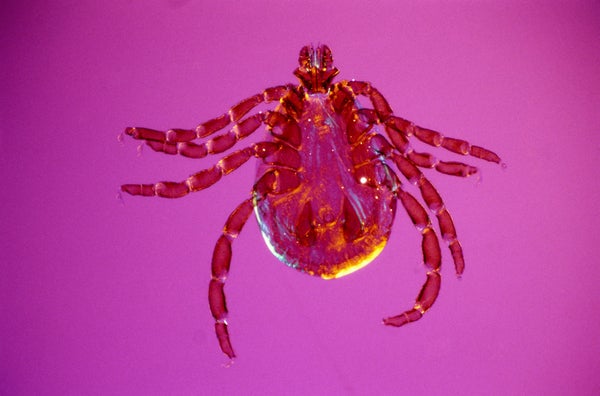

Ticks. The tiny arachnids feed on the blood of mammals, birds, and sometimes even reptiles and amphibians. And disease-causing parasites travel in that blood, from tick to victim and from victim to tick. The most familiar tick-borne illness is probably Lyme disease, but ticks can also transfer Rocky Mountain spotted fever, tularemia, Q fever, and even a form of encephalitis. Without treatment, many of these diseases can be fatal.
Keeping tick populations in check is thus good for public health. And it seems that the mere presence of large wildlife helps. Because a new study done in Kenya finds that areas without large wildlife saw tick populations rise as much as 370 percent. The finding, in the Proceedings of the Royal Society B, caught researchers by surprise—because ticks love to land on large animals. [Georgia Titcomb et al., Interacting effects of wildlife loss and climate on ticks and tick-borne disease.]
"We expected if we lost large animals that we would also lose ticks."
On supporting science journalism
If you're enjoying this article, consider supporting our award-winning journalism by subscribing. By purchasing a subscription you are helping to ensure the future of impactful stories about the discoveries and ideas shaping our world today.
University of California, Santa Barbara, ecologist Georgia Titcomb.
Before they get to their big targets, such as deer or antelopes, ticks attack small mammals, like rodents.
"So what we found is when you lose the large animals, you have an increase and a hyper-abundance of these rodents." Because those rodents are not being eaten, or simply displaced, by the bigger animals missing from the environment.
So the ticks happily feed on the rodents, after which they’d normally look for a bigger animal to parasitize before reproducing. Now, with no large mammals available, humans could become an attractive tick target—and more likely to come down with the various tick-carried conditions.
The study demonstrates one of the many ways in which biodiversity loss can be detrimental not just for wildlife but for people, too. The researchers are now doing similar work in California to see how if the Kenya findings hold elsewhere. Because lions, tigers and bears may seem scary. But the more likely danger to humans comes from ticks.
—Jason G. Goldman
[The above text is a transcript of this podcast.]
