
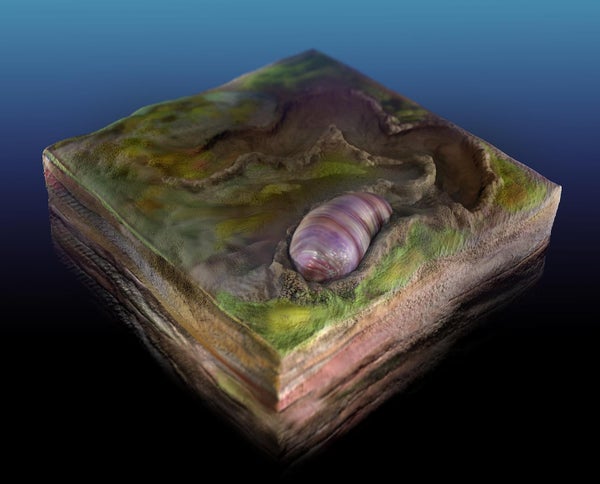

Half a billion years ago, there existed a wormlike creature the size of a grain of rice. And a new study finds that this animal may have been the first to crawl around the seafloor, gobble up organic matter at one end and poop it out the other end. The creature, dubbed Ikaria wariootia, was probably one of our oldest relatives.
“Ikaria is maybe the oldest bilaterian animal that we find in the fossil record. So this is twice as old or more than things like dinosaurs.”
University of California, Riverside paleontologist Scott Evans. He says animals like sponges are even more ancient, but they lack the bilateral symmetry that characterizes most animals today.
On supporting science journalism
If you're enjoying this article, consider supporting our award-winning journalism by subscribing. By purchasing a subscription you are helping to ensure the future of impactful stories about the discoveries and ideas shaping our world today.
“So a front and a back and a symmetrical left and right side. And bilaterians also have an opening for food to go in, an opening for waste to go out and a gut connecting them, basically a tube. And really, most animals, everything from insects to mammals to us, those are all bilaterians that are around today.”
Evans and his colleagues discovered the humble creatures in fossil layers from the Ediacara Hills of South Australia. They used 3-D laser scanners from NASA to make high-resolution images of Ikaria and the surfaces they lived on. The scans confirmed the animals’ bilateral body morphology and revealed the shape of the burrows they left from scavenging the seafloor.
“It probably had a body that was divided into what we refer to as modules, or units or segments. And because of the way it moved through the sediment, we think it had muscles and probably moved similar to how an earthworm moves by sort of extending and contracting its body using those muscle groups.”
Later animals built off of Ikaria’s basic body morphology—which featured a small front end and a larger rear end.
“It doesn't have a head or a tail, but it’s starting that type of body organization by which things can build a head and a tail.”
What’s more, Ikaria had the ability to sense the environment around it.
“And sense where food was and where oxygen was, which is also a critical evolutionary step in these early animals.”
The study is in the Proceedings of the National Academy of Sciences. [Scott D. Evans et al., Discovery of the oldest bilaterian from the Ediacaran of South Australia]
It might not seem like we share that much with a 555-million-year-old fossil, but looks can be deceiving. There’s probably a little bit of Ikaria in all of us.
—Susanne Bard
[The above text is a transcript of this podcast.]
