
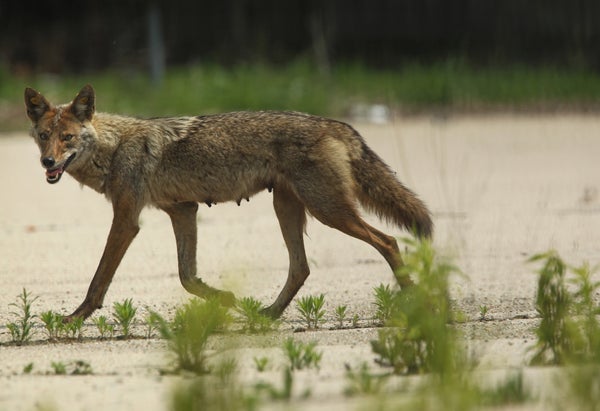

Coyotes are now common residents of many large urban areas. And while it doesn't happen all that often, coyotes are increasingly coming into conflict with people and pets.
"They're these mid-sized carnivores, [though] most people see them just as large carnivores.”
University of Washington-Tacoma evolutionary biologist Christopher Schell.
On supporting science journalism
If you're enjoying this article, consider supporting our award-winning journalism by subscribing. By purchasing a subscription you are helping to ensure the future of impactful stories about the discoveries and ideas shaping our world today.
“Being in a city like Los Angeles or Chicago or New York is just mind-boggling and awe-inspiring. In some instances, for a lot of people because they don't know much about the animals, it could be something that generates fear because of misunderstandings."
Schell wants to understand how coyotes come to feel so comfortable around people—so he can come up with strategies for preventing it. And he suspects it might have something to do with the parenting.
"Our main goal was to see and test whether or not parents that have extended experience with people and human disturbance get habituated to the point where they transfer that habituation and that fearlessness to their offspring."
Schell and his team focused on eight coyote families living at the U.S. Department of Agriculture's Predator Research Facility in Utah. Though captive, they live in large enclosures and lead mostly typical wild lives.
Typically the coyotes are fed in such a way as to minimize human contact. But for this experiment, the researchers did something different.
"Instead of just walking away immediately, we fed them, and then we just stared at them."
Turns out that when parents became more fearless around people—that is, they became perfectly happy to eat while people were watching them—their offspring became more fearless as well. And each litter of coyote pups was more fearless than the last. In fact, the most cautious pup from the second litter was bolder than the boldest pup from the first litter!
That means that an entire family of coyotes can become completely habituated to humans in just two or three generations. And that's when they get into trouble.
"Regardless of what type of behavioral phenotype an animal has, it seems like all of the animals, without any selective cost to being bold towards people, are finding out that being bold is an advantage in an urban area."
Which means those of us who live in coyote country need to work together to send a signal to coyotes that being bold is a disadvantage. And that starts with doing everything we can to ensure that our yards are as uninviting—and unappetizing—as possible.
—Jason G. Goldman
(The above text is a transcript of this podcast)
[Christopher J. Schell et al. Parental habituation to human disturbance over time reduced fear of humans in coyote offspring.]
