

Kendra Pierre-Louis: For Scientific American’s Science Quickly, I’m Kendra Pierre-Louis, in for Rachel Feltman. You’re listening to our weekly science news roundup.
First up: vaccines. On Thursday and Friday of last week the Centers for Disease Control and Prevention’s Advisory Committee on Immunization Practices, or ACIP, met to review and vote on recommendations for official U.S. vaccine guidelines.
Here to give us an update is Lauren Young, associate editor for health and medicine at Scientific American.
On supporting science journalism
If you're enjoying this article, consider supporting our award-winning journalism by subscribing. By purchasing a subscription you are helping to ensure the future of impactful stories about the discoveries and ideas shaping our world today.
Lauren Young: The major point of discussion was the hepatitis B birth dose of the vaccine. So this has historically been, since 1991, a three-dose regimen that typically begins hours after birth, regardless of whether or not a parent has tested positive or negative for the virus that causes this disease.
So after a lot of heated discussion and deliberations and tabling this vote twice, first in September and again this past Thursday, the panel voted to recommend parents would need to consult with a health care provider about when to give a baby their first dose of the vaccine, so long as the birthing parent tested negative for the disease.
And finally, after a lot of discussion and contention, the ACIP members also passed a second vote to recommend that parents discuss the subsequent doses of that three-dose regimen with a health care provider based on blood tests of the newborn’s immunity levels—those are the protective antibody titers.
It's important to note that we have a lot of data and studies that clearly demonstrate the previous three-dose regimen beginning at birth helped drastically reduce cases of childhood hepatitis B; it essentially virtually eliminated it from the U.S. Multiple health experts I spoke to say that the new vote could slowly erode all this progress we made.
So under this recommendation the vaccine should still be covered by most insurance. But Rochelle Walensky, former CDC director, has noted that this could ultimately still weaken access because it's reliant on people having that discussion with doctors.
So the next steps are ACIP’s votes go to the acting CDC director, who makes the final call on approving the recommendation. The CDC usually always adopts ACIP’s guidance.
You can follow developments on this story on ScientificAmerican.com.
Pierre-Louis: The ACIP’s meeting comes amid attacks on vaccine policies by the Trump administration. SciAm published a story last week about reports that the Food and Drug Administration is considering changes to the way COVID vaccines and other vaccines are approved and administered. The agency is reportedly exploring making the vaccine-approval process for pregnant people more stringent. It’s also revisiting whether flu and COVID immunizations can be given at the same time, according to an internal memo reviewed by the Washington Post and other news outlets. Experts say some of the proposed changes would raise costs and make childhood vaccinations less accessible.
In the memo, FDA chief medical and science officer Vinay Prasad says, without evidence, that these proposals follow the agency’s discovery of links between the deaths of 10 children and COVID vaccination. That’s compared to an estimated 1,200 children who died in the U.S. from the infection between 2020 and 2023. And in the memo he provides little information about the cases, failing to mention details such as which vaccine was supposedly to blame and how the agency made its determinations. Health and Human Services Secretary Robert F. Kennedy Jr. has also consistently expressed skepticism about vaccine safety and efficacy and has expressed beliefs that discredit germ theory. Earlier this year RFK Jr. gutted funding for the development of mRNA vaccines to protect against illnesses such as COVID, and just last month the Centers for Disease Control and Prevention posted about potential links between autism and vaccines, a scientifically discredited talking point.
Vaccine-preventable diseases are on the rise as well. As of December 2 the U.S. has seen roughly 1,800 confirmed cases of measles this year, primarily in unvaccinated people. There have been three confirmed deaths, but even after someone seems to recover in very rare cases a measles infection can have fatal consequences. Subacute sclerosing panencephalitis is a progressive neurological disorder that tends to develop seven to 10 years after a measles infection. A school-age child who caught measles as an infant, when they were too young to get vaccinated, died from the condition this year.
If all of this feels exceedingly dark, well, a study published last Wednesday in Nature found that sometimes light is the problem. The researchers concluded that light pollution from so-called megaconstellations like SpaceX’s Starlink is a threat to space-based astronomy. The number of satellites in low-Earth orbit has increased nearly eightfold since 2019, the year of the first Starlink launch. It has exploded from roughly 2,000 back then to roughly 15,000 today, according to the study. Each one of those satellites reflects light, acting like a little beacon in the sky. At first blush that sounds kind of lovely, right? But because of their reflective nature, as satellites move through space, they create long streaks of light across astronomical images, potentially interfering with scientists’ observations.
While there have been some attempts to make satellites less visible, including by putting dark coatings on them, these attempts haven’t made much difference in how bright the spacecrafts’ trails are to the observational equipment used by astronomers, according to the study. But while much attention has focused on how these satellites are affecting space observation conducted from Earth, the researchers say less has been paid to their impacts on space telescopes. That was the focus of their new study.
Companies plan to grow the number of satellites in low-Earth orbit to roughly 560,000 by the end of the 2030s. In the study the researchers simulated how things would change for space telescopes if the businesses follow through on their intentions. The scientists looked at the potential impacts on four space telescopes, including the Hubble Space Telescope, NASA’s recently launched SPHEREx and two planned space telescopes, the European Space Agency’s ARRAKIHS mission and China’s Xuntian (Sheen-Tyan) observatory.
The team found that the projected number of satellites would leave at least one trail in about 40 percent of Hubble’s images and of the three other telescopes’ more than 96 percent of observations would have trails. That is a drastic increase compared with a 2023 study that found that 4.3 percent of the images captured by Hubble between 2018 and 2021 had satellite trails on them. If steps aren’t taken to address this light pollution, the dark skies that astronomers rely on to help us better understand the universe could end up further out of reach—and we’d all be the poorer for it.
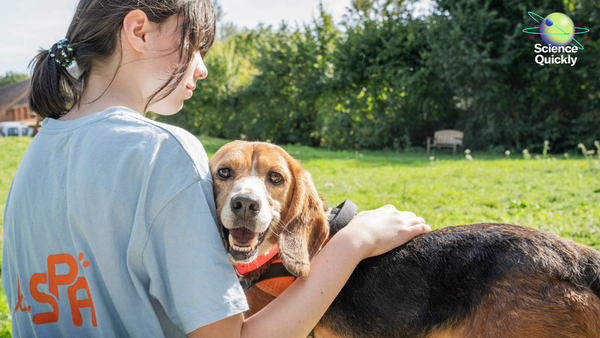
To wrap things up, let's talk four-legged friends. A study published last Wednesday in iScience suggests that fido’s cute face might not be the only thing giving teen dog owners a mental health boost. Kids with canines may also be benefiting from microbiota changes associated with dog ownership.
The study found that 13-year-olds who lived in homes with dogs had significantly lower rates of social problems than their pup-less peers. And while previous research has suggested man’s best friend provides broader companionship benefits that could help explain this phenomenon, the scientists in the new study also found different microbiome makeups in samples from teens with dogs and those without. Specifically, kids with canines had higher levels of certain bacteria, which the researchers suspected could be tied to their psychological state.
To test this hypothesis the researchers at Azabu University in Japan treated laboratory mice with microbiota from dog-owning teens to see if it would affect the rodents’ behavior—and it did. The mice with dog-owning microbiota were more likely to exhibit prosocial behaviors like sniffing cage mates. Though the scientists say more research needs to be done, if your kid has been begging for a puppy the results make a compelling argument for bringing home a furry friend this holiday season.
That’s all for today’s episode. Tune in on Wednesday, when we dig into the effort to get samples back from Mars that could contain proof of life existing beyond our planet.
Science Quickly is produced by me, Kendra Pierre-Louis, along with Fonda Mwangi and Jeff DelViscio. This episode was edited by Alex Sugiura. Shayna Posses and Aaron Shattuck fact-check our show. Our theme music was composed by Dominic Smith. Subscribe to Scientific American for more up-to-date and in-depth science news.
For Scientific American, this is Kendra Pierre-Louis. Have a great week!
