

Sixty-five million years ago, a six-mile-wide asteroid crashed into what’s now Mexico. The impact upended Earth’s climate, driving up to three quarters of all species extinct, including the dinosaurs. That’s been the accepted explanation for mass extinction—for the last few decades, anyway.
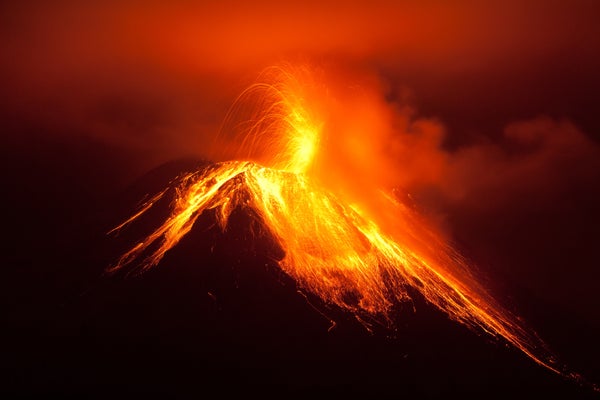
But while scientists still think the asteroid dealt dinos and their contemporaries a serious blow, some have started to wonder if there wasn’t another culprit. Around the same time, huge quantities of lava were bubbling out of present-day India, forming what scientists call a large igneous province.
“This is large and huge volumes of lava flow, erupted in very short time. Short time at our geological scale.” Eric Font, a geoscientist at the University of Lisbon in Portugal. “So imagine a small country like France or Portugal, covered by lavas. So a large igneous province is a huge eruption—huge amount of continental flood basalt and volcanic gases.”
On supporting science journalism
If you're enjoying this article, consider supporting our award-winning journalism by subscribing. By purchasing a subscription you are helping to ensure the future of impactful stories about the discoveries and ideas shaping our world today.
The gases Font refers to include carbon dioxide, sulfuric acid and other toxic compounds, which could have caused a host of problems for plants and animals—like climate change, acid rain and ocean acidification. That’s why in recent years researchers have debated whether the eruptions, which created rock formations known as the Deccan Traps, may have also played a role in causing the mass extinction.
Now Font has found more compelling evidence that that the eruptions had an impact on life. He and his colleagues identified a spike in mercury, which is produced by volcanoes, in ancient ocean sediments from southern France that span the extinction event. The spike coincides with layers of corroded shells and other indicators of environmental changes, suggesting the Deccan eruptions may have been to blame. The results were published in the journal Geology. [Eric Font et al, Mercury anomaly, Deccan volcanism, and the end-Cretaceous mass extinction]
Font’s study also raises the possibility that some of the death and destruction may have been due to mercury poisoning, of both the land and the sea. “It’s extremely toxic and it has a long residence time in the atmosphere. So, it allows mercury to travel around the world easily. It can lead to global scale perturbation.”
However, Font says the question isn’t settled yet. “Now, where we stand is: what is the contribution of the Deccan, what is the contribution of the impact.” Whatever the answer turns out to be, one thing is certain: 65 million years ago was a tough time to be a dinosaur.
—Julia Rosen
[The above text is a transcript of this podcast.]

