

[CLIP: Hermit warbler song]
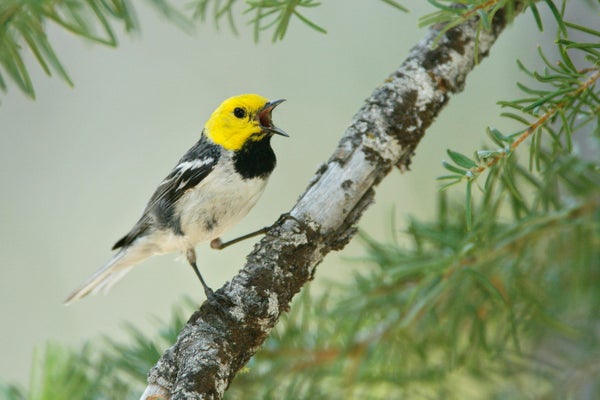
That’s a bird called the hermit warbler. It breeds along the U.S. West Coast.
“They have a cute little yellow head and a gray body.”
On supporting science journalism
If you're enjoying this article, consider supporting our award-winning journalism by subscribing. By purchasing a subscription you are helping to ensure the future of impactful stories about the discoveries and ideas shaping our world today.
Brett Furnas, a biostatistician at the California Department of Fish and Wildlife.
Typically, birds sing the same one song within one region because the song attracts mates. And different regions can have slightly different dialects of the song.
“But what we also noticed [was] that there are some places that were exceptions to this rule—that some places, there was more than one song in the same place. And so we were curious why that would be the case.”
To investigate, Furnas and his team recorded hermit warbler songs. Lots of them.
“We had to go all over California, so we went to 100 different locations throughout the state and all the different potential habitats of the species.”
The researchers analyzed all the hermit warbler songs they collected and discovered that the hermit warbler doesn’t just violate the usual one-song-per-region rule—they positively demolish it.
“Doing this over a period of 10 years, we found, actually, an amazing 35 different dialects across the state.”
Here are just two examples of dialects, slowed down for easier comparison.
[CLIP: Hermit warbler songs]
But why would the bird repeatedly alter its song when any changes could affect its ability to attract a mate? The answer is wildfire.
“Basically, the idea is that warblers are very sensitive to fire in the short term. And so they will abandon an area temporarily, even if it’s just an understory or a low-severity fire that doesn’t destroy the whole stand. And so this creates a vacuum. And then other hermit warblers singing rival dialects move in into this vacuum. And then you end up, maybe a few years later, with two or more different dialects in the same place.”
The study was published in the journal The Auk: Ornithological Advances. [Brett J. Furnas et al., Wildfires and mass effects of dispersal disrupt the local uniformity of type I songs of Hermit Warblers in California]
Even though the California Hermit Warblers sing multiple songs, Furnas says that such musical diversity might actually work in the hermit warblers’ favor.
“They may have greater resiliency to things like—that are stressors to our natural habitats, like climate change. And so understanding that helps us to make better conservation decisions to protect biodiversity. But it’s also what makes the outdoors interesting and a beautiful place to be, because you can go to one part of the state and hear hermit warblers singing a certain way, and you can go to another part of the state, and they sing a different way. And even though you might not know it’s a hermit warbler, your experience outdoors is enriched by that diversity.”
—Karen Kwon
[The above text is a transcript of this podcast.]
