
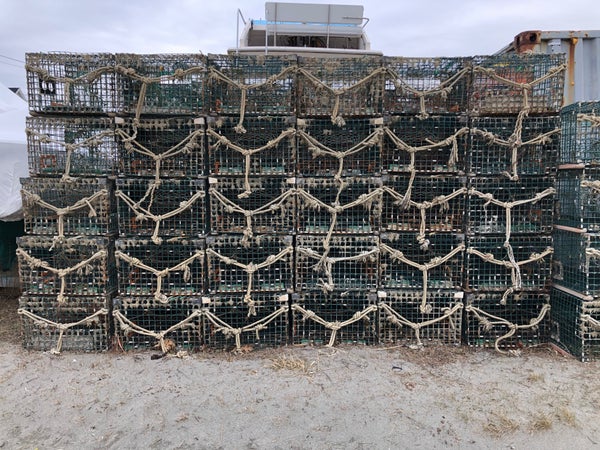

There’s a lot of cash crawling on the seafloor. American lobsters bring in more money than any other U.S. fishery—a record $670 million in 2016, mostly through Maine and Massachusetts.
The fishery relies on traditional lobster harvest techniques: a series of traps are dropped to the ocean floor with a long rope attached to a floating buoy.
“During peak fishing season, there’s over 900,000 vertical lines right in the middle of right whale habitat.”
On supporting science journalism
If you're enjoying this article, consider supporting our award-winning journalism by subscribing. By purchasing a subscription you are helping to ensure the future of impactful stories about the discoveries and ideas shaping our world today.
Graduate student Hannah Myers from the University of Alaska Fairbanks College of Fisheries and Ocean Sciences.
Those vertical lines entangle and kill endangered sea turtles and multiple whale species—including the North Atlantic right whales. Only about 400 individuals remain. And recent analyses show that the species won’t survive if humans kill an average of just one whale each year. Some estimates indicate that lobstering gear kills more than three whales each year on average.
“Management problems surrounding the North Atlantic right whale and entanglements are pretty significant and have been really challenging to move forward. And a large part of that is due to expected negative impacts on the lobster fishery.”
But right whale protections don’t have to mean lobster losses. Canada’s lobster harvest operates with fewer traps and a shorter, six-month-long season.
“The U.S. lobster fishery in Maine expends approximately 7.5 times as much as the Canadian fishery to catch the same amount. And Canadians are catching almost four times more lobsters per trap.”
They’re putting less effort into it and spending less on fuel and equipment. But they’re still gathering nearly the same amount of lobster overall. And there are stateside examples.
“In Massachusetts, areas that have had a seasonal closure in recent years have reached record-high landings.”
The study was published in the journal Marine Policy. [Hannah J. Myers and Michael J. Moore, Reducing effort in the U.S. American lobster (Homarus americanus) fishery to prevent North Atlantic right whale (Eubalaena glacialis) entanglements may support higher profits and long-term sustainability]
Restrictions could actually mean a healthier lobster population overall.
“It’s paradoxical, but it is consistent with a lot of fisheries research that shows that when you fish with too much effort, too many traps in the water, then the stock itself isn’t as robust. So one thing we might expect is you would have more or larger lobsters (if there are fewer traps in the water) coming in to each trap. And therefore you would be able to haul up more lobster per trap. And that’s kind of what we see on the Canadian side.”
Taking some of those ropes out of the water could benefit both the whales and the fishermen.
“Our main takeaway is that a negative economic impact should be not assumed with effort reduction in the U.S. lobster fishery.”
—Jason G. Goldman
[The above text is a transcript of this podcast.]
