
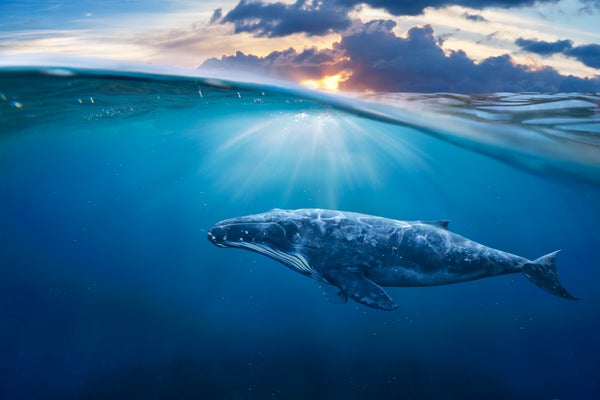

Baleen whales are the gentle giants of the sea. Despite their colossal size, they feed on tiny creatures such as krill and zooplankton. That’s because these whales, instead of teeth, have bristle-like structures in their mouth—baleen—which filters out small critters from big gulps of water. But the ancestors of baleen whales had a very different diet.
“So, the oldest whales that we know—these are the ancestors not just of the great whales like the blue whale and the humpback whale, but also of all of the dolphins in the sea today—they had fairly big teeth.”
Felix Marx, a postdoctoral research fellow at the Royal Belgian Institute of Natural Sciences.
On supporting science journalism
If you're enjoying this article, consider supporting our award-winning journalism by subscribing. By purchasing a subscription you are helping to ensure the future of impactful stories about the discoveries and ideas shaping our world today.
“And the most common idea is that they ate relatively large fish, and for some of the biggest ones… there are some studies that looked specifically of the wear of those teeth at the microscopic level, and they seem to suggest that they ate almost anything that they came across. The point is that they had big teeth that were really sharp, and that were even, relative to the size of their jaws, were relatively large, so they were really predators.”
So where did baleen come from? Marx and his colleague Ewan Fordyce set out to answer this question. They analyzed the mouth of a 34-million-year-old fossil of one of the earliest baleen whales, called Llanocetus denticrenatus, found in Antarctica. And they concluded that Llanocetus had sharp teeth and large gums—but no baleen.
Their findings argue against one of the ideas about how baleen evolved—that at some point whales had both teeth and baleen. “Llanocetus is the first and it’s the only specimen, the only species, the only archaic whale, that makes a very clear case that, no, this coexistence of baleen and teeth, as it was just imagined basically…based on what modern whales looked like, didn't work. It didn't exist in that sense.” The finding is in the journal Current Biology. [R. Ewan Fordyce and Felix G. Marx, Gigantism Precedes Filter Feeding in Baleen Whale Evolution]
So how did some whales go from chomping predators to filter feeders? “Baleen is effectively an outgrowth of the gums, and that probably only happened once the teeth had already been lost or maybe had been severely reduced. So we suggest this intermediate phase where you start with teeth and biting, then you start sucking your food, then because you suck in small things, you start to develop a filter and eventually you become a proper filter feeder.”
—Annie Sneed
[The above text is a transcript of this podcast.]
