

“And tomorrow I’ll be marching, because don’t you think Millie would agree with the March for Science.”
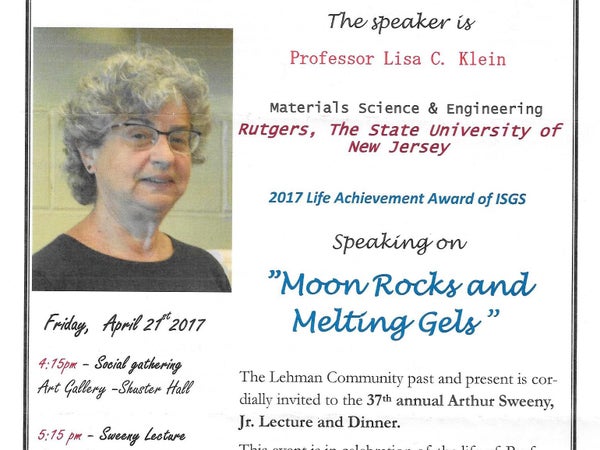
Lisa Klein, from the materials science and engineering department at Rutgers University in New Jersey. On Friday evening, April 21st, she gave a talk to the chemistry department at Lehman College in the Bronx. She was filling in for the scheduled speaker, her friend Millie Dresselhaus, who sadly died in February at the age of 86. Dresselhaus, who was raised in the Bronx, was the recipient of the National Medal of Science and the Presidential Medal of Freedom.
“On Earth Day we need to take care of our planet, remind others it’s the only one we have. And the March for Science in New Jersey is in Trenton. The emblem for the march in D.C. is Science, Not Silence because science means fact-based policies, free inquiry, strong public education.”
On supporting science journalism
If you're enjoying this article, consider supporting our award-winning journalism by subscribing. By purchasing a subscription you are helping to ensure the future of impactful stories about the discoveries and ideas shaping our world today.
She also told a story about an incident that might have helped motivate her decision to march for science. She mentions STEM, which stands for science, technology, engineering and match, usually in an educational context.
“On March 28th, Education Secretary DeVos and the president’s daughter were filmed taking a group of young women to the National Air and Space Museum, where the president’s daughter said that the boys should empower the girls to stay in STEM, and I ask do we really need the boys’ permission? And shortly after that the budget was delivered to Congress where the president removed NASA’s Office of Education, which works to promote STEM for girls along with other educational initiatives. Let’s move on.” [laughter]
—Steve Mirsky
[The above text is a transcript of this podcast.]
