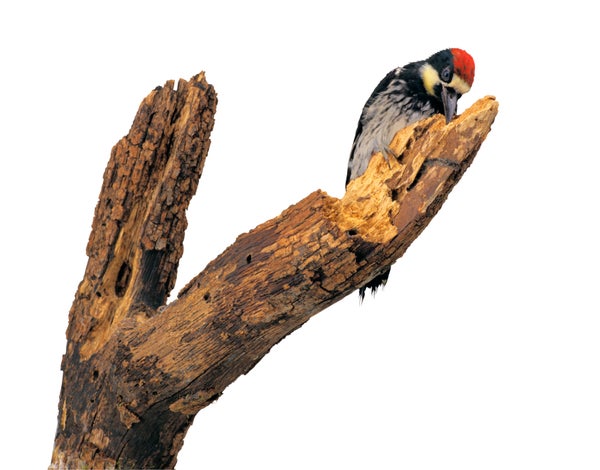
Woodpecker Head Bangs Communicate Info

Woodpeckers that listen to others of their kind drum into trees alter their behavior based on what they hear.   


GETTY (MARS)

Illustration of a Bohr atom model spinning around the words Science Quickly with various science and medicine related icons around the text

Join Our Community of Science Lovers!

[Pretty bird song]

Some birds produce beautiful songs.

[Woodpecker drumming]


On supporting science journalism

If you're enjoying this article, consider supporting our award-winning journalism by subscribing. By purchasing a subscription you are helping to ensure the future of impactful stories about the discoveries and ideas shaping our world today.


Woodpeckers are not among them. The most familiar sound they make is when they tap on tree trunks with their bills to produce what’s called “drumming."

"This drumming that they show is essentially them kind of slamming their head against a tree at remarkable speeds.” Wake Forest University biologist Matthew Fuxjager.

“Some of the woodpeckers will use this kind of drumming-type maneuvering to excavate a nest, they'll make little caches in a tree to store food, or some of them will actually forage that way. But then they also use it for this social signal."

Fuxjager’s team broadcast the pre-recorded sounds of head slams to mated pairs of downy woodpeckers in the woods nearby. They discovered that there's a lot of information communicated in the drumming.

For example, woodpeckers that produce shorter drums are probably kind of wimpy, and easy to beat in a fight. But if a drum is longer, the challenger might be advertising itself as a stronger, tougher bird, one that's a bit harder to fend off.

And after hearing recordings of long drums, pairs of birds begin to coordinate the defense of their territory. They don’t bother with such behavior after short drums. [Eric R. Schuppe, Gloria D. Sanin and Matthew J. Fuxjager, The social context of a territorial dispute differentially influences the way individuals in breeding pairs coordinate their aggressive tactics, in Behavioral Ecology and Sociobiology]

The researchers think that this kind of coordination might have evolved because woodpeckers invest so much time and energy carving out their nest hole in a tree. If they were kicked out and had to start over, they might not get a chance to reproduce and fledge their offspring. By responding only to more realistic threats, woodpecker pairs can conserve energy to be expended at the hard work of raising their headstrong chicks.

—Jason G. Goldman

[The above text is a transcript of this podcast.]


Jason G. Goldman is a science journalist based in Los Angeles. He has written about animal behavior, wildlife biology, conservation, and ecology for Scientific American, Los Angeles magazine, the Washington Post, the Guardian, the BBC, Conservation magazine, and elsewhere. He contributes to Scientific American's "60-Second Science" podcast, and is co-editor of Science Blogging: The Essential Guide (Yale University Press). He enjoys sharing his wildlife knowledge on television and on the radio, and often speaks to the public about wildlife and science communication.

More by Jason G. Goldman

It’s Time to Stand Up for Science

If you enjoyed this article, I’d like to ask for your support. Scientific American has served as an advocate for science and industry for 180 years, and right now may be the most critical moment in that two-century history.

I’ve been a Scientific American subscriber since I was 12 years old, and it helped shape the way I look at the world. SciAm always educates and delights me, and inspires a sense of awe for our vast, beautiful universe. I hope it does that for you, too.

If you subscribe to Scientific American, you help ensure that our coverage is centered on meaningful research and discovery; that we have the resources to report on the decisions that threaten labs across the U.S.; and that we support both budding and working scientists at a time when the value of science itself too often goes unrecognized.

In return, you get essential news, captivating podcasts, brilliant infographics, can't-miss newsletters, must-watch videos, challenging games, and the science world's best writing and reporting. You can even gift someone a subscription.

There has never been a more important time for us to stand up and show why science matters. I hope you’ll support us in that mission.

Thank you,

David M. Ewalt, Editor in Chief, Scientific American

Subscribe