
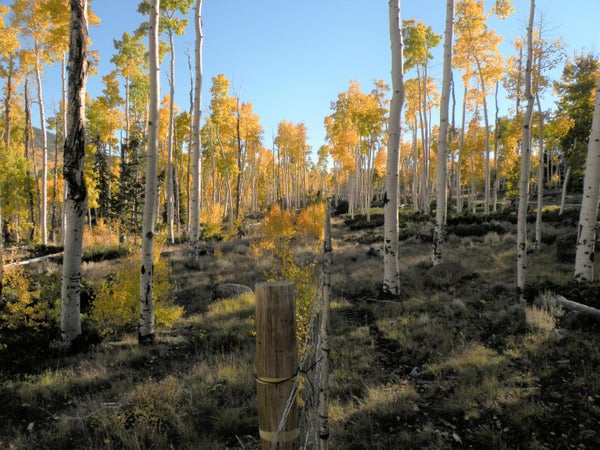

It lives in south-central Utah. And it’s huge. In fact, it is thought to be the largest living thing on the planet. It’s a stand of trees, a field of aspens all clones and all connected at the roots. Called Pando, the grove was first characterized by scientists in the 1970s, and it’s probably existed for many thousands of years. But now a study finds that this this massive, ancient organism is failing.
“More than 80 percent of the entire Pando clone is in a nonsustainable state that has the potential to collapse and significantly reduce the size of this world’s largest organism in the next 10 to 20 years.” Paul Rogers, director of the Western Aspen Alliance at Utah State University.
The cause of this crisis? Herbivores, mostly deer. Parts of Pando are fenced off, but that section is still under attack. “Young aspen trees are so nutritious that animals really want to get them, particularly late in the year when the rest of the forest plants are senest and dried up..., I think that there’s perhaps some very healthy [animals that] are able to jump over the eight-foot fence.”
On supporting science journalism
If you're enjoying this article, consider supporting our award-winning journalism by subscribing. By purchasing a subscription you are helping to ensure the future of impactful stories about the discoveries and ideas shaping our world today.
The deers’ aggressive browsing of young aspen poses a huge threat to Pando. “We see a big gap in the demography. And I often use the human analogy that this is a forest that is almost completely composed of senior citizens, and we have no mature, healthy individuals, we have no middle-aged, we have no teenagers, we have no babies. And that’s a really dangerous situation for aspen because it really depends on continuous growth of the whole clone. You should have a really diverse age and height structure.”
The problem has largely been created by humans and our game management strategies. Rogers says those strategies need to be reconsidered if we want to protect Pando. And it’s not just about saving the world’s largest organism for its own sake.
“Aspen here and, in fact, worldwide harbor great amounts of biodiversity…, hundreds of plants and animals that are dependent on aspen ecosystems. In the Western U.S., the lower 48, aspen, second to riparian systems, are the most biodiverse forests that we have. Another term for that is Aspen is a keystone species. So as aspen goes so do all those dependent species. So that’s the number one reason.
“Specific to Pando, this closely demarcated 106 acres or 43 hectares is something that’s workable that we can see and feel and look at and people know about or are learning more about. And so…as a conservation symbol it’s like, if we can’t fix this one thing that has this international reputation, what does that say about our greater relationships with the Earth and living compatibly with the planet?”
—Annie Sneed
[The above text is a transcript of this podcast.]
