
Physics Week in Review: November 22, 2014
Here’s a disquieting thought for your weekend: Dark Energy Might Be Stealing the Glue Holding the Universe Together. A new invisibility cloak simultaneously works for heat flow and electrical current.


Physics Week in Review: November 22, 2014
Here’s a disquieting thought for your weekend: Dark Energy Might Be Stealing the Glue Holding the Universe Together. A new invisibility cloak simultaneously works for heat flow and electrical current.
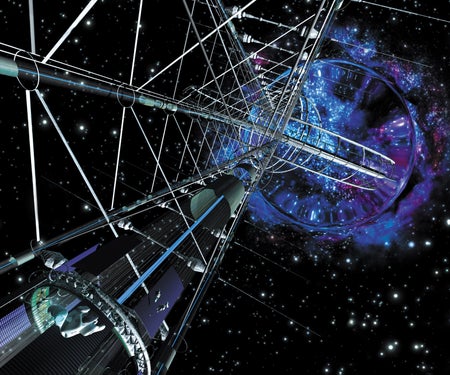
Are Scientists on the Cusp of Knowing How Weird We Are?
I’m writing this post for two reasons. One is to recommend a new book by Columbia astrobiologist Caleb Scharf (who also writes a terrific Scientific American blog, “Life, Unbounded“), and the other is to defend an old book of mine.


What "Interstellar" Gets Wrong about Interstellar Travel
Christopher Nolan’s new film, Interstellar, is a near-future tale of astronauts departing a dying Earth to travel to Saturn, then through a wormhole to another galaxy, all in search of somewhere else humanity could call home.

A High-Flying Web May Catch the Beginning of Time
This winter an airborne experiment named Spider will probe the earliest remnants of the universe

Physics Week in Review: November 8, 2014
It was a big week for physics in the movies, with the premiere of Interstellar, and the Stephen Hawking biopic The Theory of Everything. That translates into lots of pixels commenting on the science behind the films.

Physics Week in Review: November 1, 2014
Hope everyone enjoyed their Halloween festivities. Here’s a few other related links: The ghostly glow of St. Elmo’s fire: it works the same way that a neon light glows. The Levitating Halloween Pumpkin with a superconductor inside. Bonus: More Conceptual Physics Halloween Costumes.This year, go out as The Holographic Principle!

'Theory of Everything' Brilliantly Dramatizes Paradox of Modern Science
I met Stephen Hawking in the summer of 1990, when I spent five days in northern Sweden at a conference attended by 30 or so leading cosmologists.

In Einstein's Universe, Airplanes and Staircases Are Time Machines
Some experimental optical clocks are so precise that even a small change in elevation or velocity makes them register the passage of time differently

How to Build a Time Machine
It wouldn't be easy, but it might be possible

Surfer-Physicist Offers Alternative to String Theory, Academia
In 2007 Garrett Lisi was a 39-year-old physicist, unaffiliated with any institution, toiling in obscurity on what he called "An Exceptionally Simple Theory of Everything,” which could account for all of nature’s forces.

Predictions for the 2014 Nobel Prize in Physics
Excitement is building — at least in science circles — for the upcoming announcements of the 2014 Nobel Prizes, along with the inevitable speculation about who might be among this year’s winners.

How Big Bang Gravitational Waves Could Revolutionize Physics
If the recent discovery of gravitational waves emanating from the early universe holds up under scrutiny, it will illuminate a connection between gravity and quantum mechanics and perhaps, in the process, verify the existence of other universes