
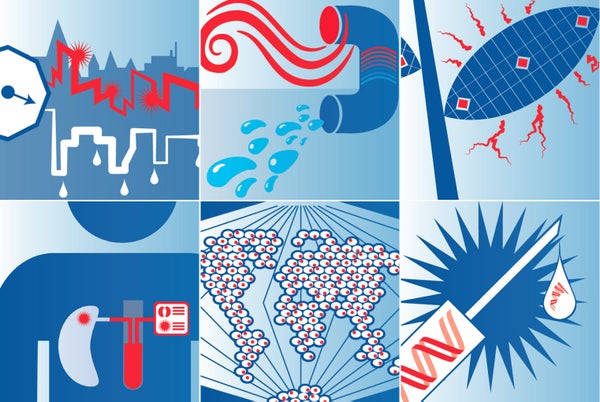
What if drinking water could be drawn from desert air easily, without requiring enormous amounts of electricity from a grid? What if a doctor could do a biopsy for a suspected cancer without a blade of any sort? What if we didn’t have to wait too long to find out? Technologies that make these visions a reality are expected to become increasingly commonplace in the next few years. This special report, compiled and produced in a collaboration between Scientific American and the World Economic Forum’s Expert Network, highlights 10 such emerging technologies.
To choose the entrants in this year’s emerging technologies report, we convened a steering group of world-renowned technology experts. The committee made recommendations and elicited suggestions from members of the Expert Network, the forum’s Global Future Councils, Scientific American’s board of advisers and others who are tuned in to burgeoning research and development in academia, business and government. Then the group whittled down the choices by focusing on technologies that were not yet widespread but were attracting increased funding or showing other signs of being ready to move to the next level. The technologies also had to offer significant benefits to societies and economies and to have the power to alter established ways of doing things. We hope you enjoy the result, and, as always, we welcome your feedback. Read the full report on the Top 10 Emerging Technologies of 2017 here, and download it here.
Mariette DiChristina, editor in chief, Scientific American, and chair, Emerging Technologies Steering Group
On supporting science journalism
If you're enjoying this article, consider supporting our award-winning journalism by subscribing. By purchasing a subscription you are helping to ensure the future of impactful stories about the discoveries and ideas shaping our world today.
Bernard Meyerson, chief innovation officer, IBM, and vice chair, Emerging Technologies Steering Group