
1972
Tectonic Dump
“A speculative but intriguing scheme for disposing of man-made solid wastes has been put forward by two investigators at the University of Washington. The plan would take advantage of regions called subduction sinks, where sedimentary material is being drawn downward into the earth’s mantle as a consequence of seafloor spreading. A hypothetical disposal system would consist of three stages: collection, compaction of waste into blocks and its sea transportation to tectonic sinks. The one-way system would take care of quantities larger than we can produce.”
On supporting science journalism
If you're enjoying this article, consider supporting our award-winning journalism by subscribing. By purchasing a subscription you are helping to ensure the future of impactful stories about the discoveries and ideas shaping our world today.
Fiber-Optic Television
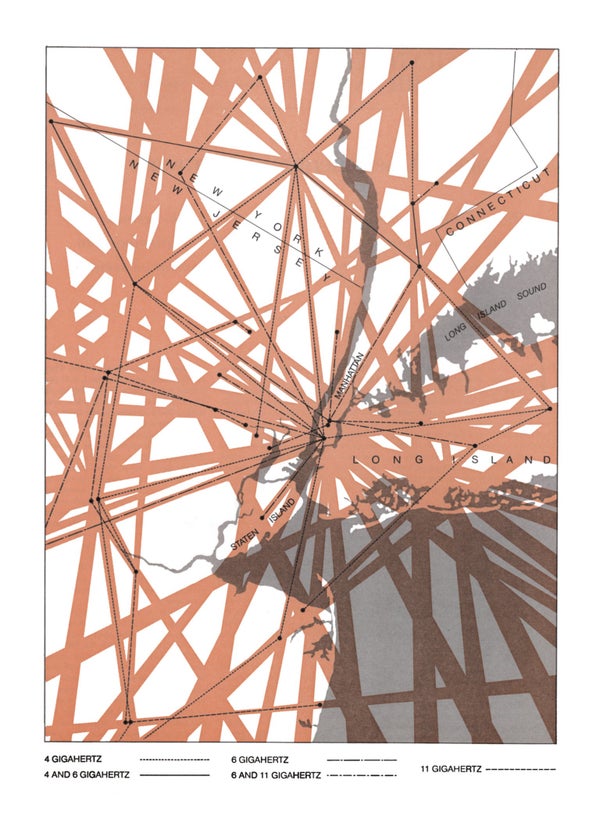
“The use of a laser beam as a high-capacity channel for carrying voice, video, digital and other signals has seemed an attractive possibility. A single coherent beam of laser light can in principle carry the equivalent of several thousand television channels. Until recently it seemed that if a laser beam was to be useful in communications, it would have to travel in a carefully designed pipe complete with lenses and other features enabling the light to bend around corners. A much more attractive possibility is to use thin glass fibers to carry the laser beam. At the Bell Telephone Laboratories, experimental fibers have been made that exhibit an absorption loss of about 60 decibels per kilometer, and fibers with a loss as low as 18 decibels per kilometer have been made by the Corning Glass Works. With repeaters spaced every mile or two, glass-fiber systems could be a strong contender for future long-haul transmission applications.”
1922
Nuclear Power from Coal?
“Atoms, those smallest bricks of nature, are the seat of unbounded energy. Scientists are today of the opinion that radioactivity is not only a property of radium, uranium or thorium atoms, but that it is common to all atoms, only that in other atoms this power is latent. If it were possible to start the decomposition of the atoms, the radioactivity must appear. The quantity that could be won by such means is infinitely greater than that attained by chemical reaction or combustion. We have produced energy from coal [through combustion]. If it were possible to break up the atoms and cause them to spend their latent energy, an ocean liner of 50,000 horsepower could travel across the oceans uninterruptedly for ten years using only a single kilogram of coal. Perhaps there will come a time when we shall use the energy in the atoms to drive our machines, cook our food and heat our rooms.”
1872
Mastodons in New York
“A farmer in the town of Mount Hope, Orange County, N.Y., digging recently in a swamp on his premises, exhumed from the muck, about eight feet below the surface, a number of bones which, from their size and formation, are supposed to be those of a mastodon. There are two ribs nearly five feet long, and two sections of vertebrae six inches wide. Several discoveries of mastodon remains have been made in this county during the past thirty or forty years.”
The Channel Tunnel
“The successful completion and operation of the Mont Cenis railway tunnel through the Alps has given new impetus to establishing railway communication between England and France, by means of a tunnel under the British Channel. The distance is 22 miles. The Channel Tunnel Company has been formed in London to solve the problem. The tunnel is to extend from Dover, England, to Calais, France. The tunnel will be made through the lower or gray chalk, chiefly, if not entirely, and by the adoption of machinery. Any [cost] estimate must at present be purely conjectural, but it is reckoned that the work, if practicable at all, could be completed within five years and for $25,000,000.”
No channel tunnel was built until Eurotunnel opened the “Chunnel” in 1994, between Folkestone, England, and Coquelles, France. Price tag: about £9 billion.
