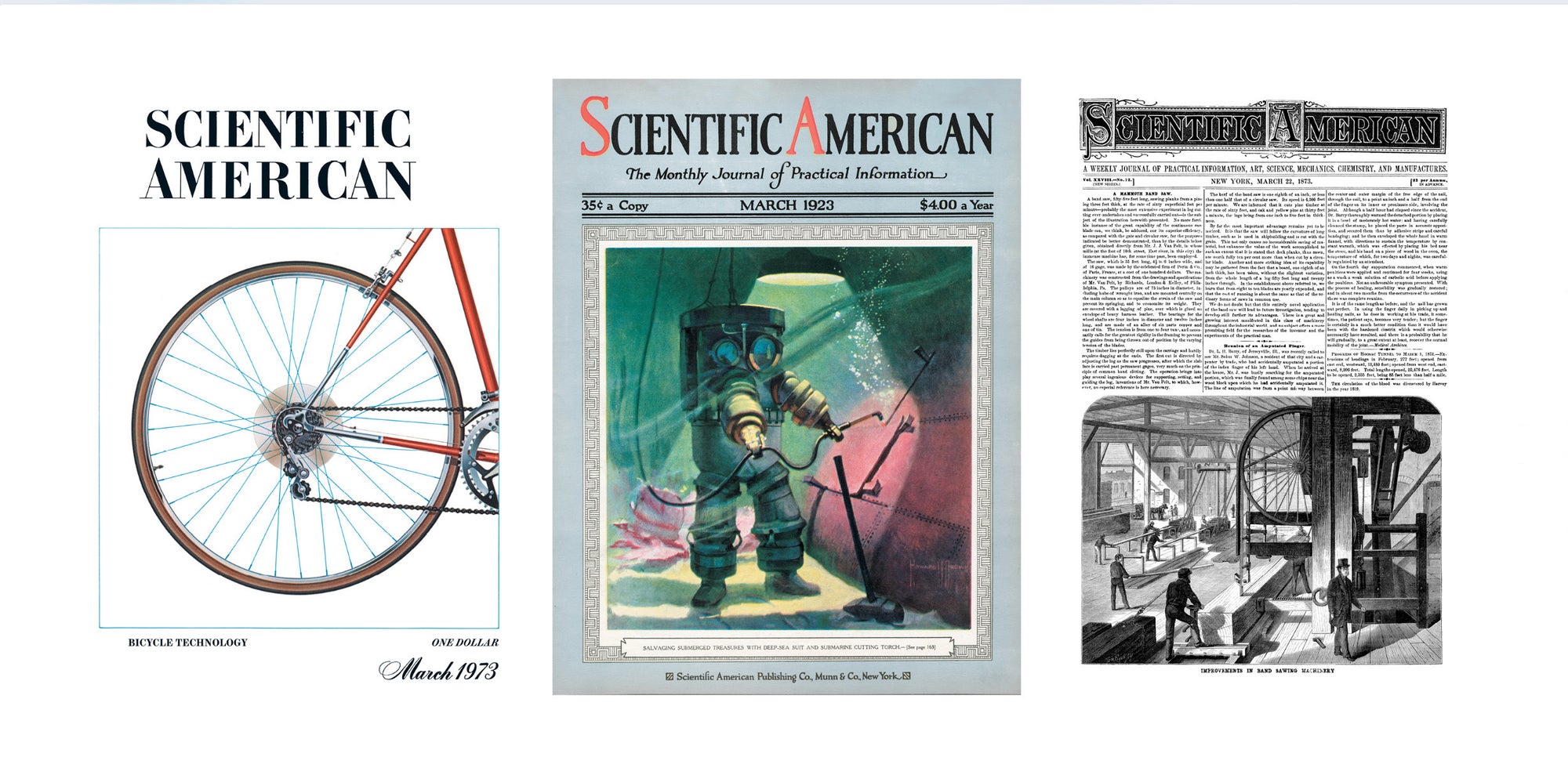
1973
Eight Billion People
“The human population is now about 3.6 billion. An extrapolation of demographic trends that lies between two extreme projections shows it leveling off at some 8.4 billion by the year 2100.”
On supporting science journalism
If you're enjoying this article, consider supporting our award-winning journalism by subscribing. By purchasing a subscription you are helping to ensure the future of impactful stories about the discoveries and ideas shaping our world today.
The United Nations estimates that world population reached eight billion on November 15, 2022. It predicts nine billion people by 2037.
Roe v. Wade Decided
“In the U.S., abortion will henceforth be regulated on the basis of medical standards and practices, rather than according to socioreligious principles enforced by criminal law. Abortion will nevertheless not become a primary method of fertility control. These are among the conclusions reached by legal and medical specialists in the wake of the U.S. Supreme Court's January decisions striking down almost all provisions of most of the state laws prohibiting and regulating abortion. The Court held that abortion is so safe in the first three months of pregnancy that states may not interfere at all with a decision by a woman and her physician at that stage. In the second and third trimesters states may regulate the practice of abortion, but only in ways ‘reasonably related to maternal health.’ Some proponents indicated that they would now work for the complete elimination of all criminal legislation, holding that abortion should be treated like any other medical procedure and regulated by the medical profession, civil law and health codes.”
On June 24, 2022, the U.S. Supreme Court overturned Roe v. Wade.
1923
Lead Paint Propaganda
“In the recent meeting of the International Labor Congress at Geneva a resolution was passed barring the use of white lead in paints. It was pointed out that these paints are very poisonous and that the white lead pigment can be replaced to good advantage by other white pigments, particularly by titanium white, developed commercially in Norway. There has been a great deal of uncalled-for propaganda against the use of white lead because of its poisonous properties. It is of course true that white lead is poisonous, but so are a great many other substances which are in common daily use. If just the ordinary care is taken with paint, whether it contains white lead or not, there need be no fear of any poisonous or other deleterious effects.”
1873
Kant and Goethe Torn Down
“Mere reasoning, not based on sufficient observation of Nature, almost always leads to false conclusions and baseless theories. This was the main fault of ancient philosophers, and is still the fault of that class of moderns. Even some of the most eminent individuals have erred in this way. One such is the famous German philosopher Emanuel Kant, who wrote a volume on dynamics, or rather, on a false imaginary theory of motion, which he calls dynamics. It shows how superficial a thinker Kant was after all. Another illustration is Goethe, who in the latter years of his life wrote a volume on light and colors, in which he proves that he had not the least capability of making experiments, and was still more deficient in his powers of observation. His conclusions are almost all false. We consider it a necessary and progressive step to tear away a portion of the halo which surrounds certain names, owing to the habit people have of regarding their heroes as superior in all respects.”
The Best Asbestos
“There are very extensive deposits of this important mineral within the limits of the United States—that found on the eastern slope of the Green Mountains and of the Adirondacks being of the best fineness and tensile strength. The fiber of New York and Vermont asbestos varies in length from two to forty inches and resembles unbleached flax, when found near the surface, but when taken at a greater depth, it is pure white, and very strong and flexible. It is found also, in considerable quantities, in the Tyrol, in Hungary, Corsica and Wales.”