
1971
When Time Began
“Specially designed equipment has been set up in two widely separated locations: my laboratory at the University of Maryland and the Argonne National Laboratory near Chicago. Within the past two years simultaneous increases in the output of detectors at these sites have provided evidence of bursts of gravitational radiation emanating from the center of our galaxy. These findings have stimulated much theorizing and a good deal of disagreement among astrophysicists. It is conceivable that the source might be an unusual object such as a pulsating neutron star. It is also conceivable that the mass at the galactic center is acting as a giant lens, focusing gravitational radiation from an earlier epoch of the universe. The relatively large intensity apparently being observed may be telling us when time began.—Joseph Weber”
On supporting science journalism
If you're enjoying this article, consider supporting our award-winning journalism by subscribing. By purchasing a subscription you are helping to ensure the future of impactful stories about the discoveries and ideas shaping our world today.
1921
Science News
“On the ground that citizens ought to be in a position to avail themselves of what science teaches, and to estimate the work of the serious scientist as well as the claims of the faker, it is essential that the people understand modern science. Under the financial support of Mr. E. W. Scripps, whose name is familiar to the readers of several hundred newspapers that use his news service, a foundation has been laid for the Science Service. It will publish books and magazines, conduct lectures and conferences, produce motion pictures, and especially will extend the willingness and the ability of the average newspaper to deal with scientific news.”
Radio at Home
“We are on the verge of a new era in radio communication, namely, radiophone music for the home. The idea is to have radiophone stations at central points sending out concert music as well as speeches and lectures via radio, and compact receiving sets in various homes and clubs to intercept the waves. Already there are several radiophone stations in operation, and at least one wireless company has developed a receiving set made as a cabinet, incorporating a concealed loud-speaking telephone unit, so that the transmission can be heard throughout a room. It is believed that leading manufacturers of radio equipment will maintain radiophone concert and lecture services for their patrons.”
1871
Superior Bread Baking
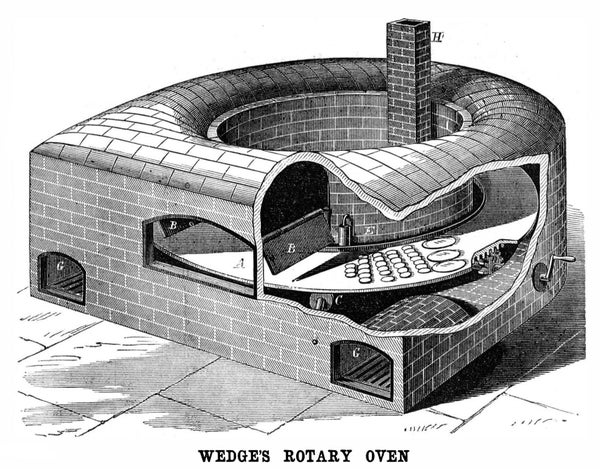
“Our engraving illustrates a newly invented baker’s oven, which seeks to combine the advantages of the old fashioned brick oven with those of continuously acting mechanical ovens. The latter have failed to produce a sweet and wholesome bread. The dough is put in, and when brought around again by the rotating platform, is taken out at the door. Swinging damper doors prevent the escape of heat. It is claimed that this oven will bake anything in the superior manner accomplished by the brick oven. It is also said to excel in economy of fuel and labor.”
Down in the Salt Mine
“The most productive salt mines in the world are those of Wieliczka, in Austrian Poland, ten miles from Cracow. The greatest depth is about eight hundred feet. They have seven different levels. The apparatus for letting us down was an iron basket, in which we sat, with our legs hanging outside, holding to ropes fastened above to a ring encircling an iron shaft. When we stopped, one of the torchbearers went before, and the other behind me, as we walked over a wooden bridge, and down a flight of stairs, and through several passages, all cut from the salt. Salt varies a great deal in quality. The green salt contains six or seven percent of clay, which destroys its transparency. Another sort, spiza, is crystalline, but mixed with sand; the perfectly pure, szybik, is found in large crystallized masses. The yield of the mine is about 500,000 tuns annually, valued at ten dollars per tun. When the mines were discovered is not known, though it is certain that they have been worked nearly nine centuries. —Junius Henri Browne”
