
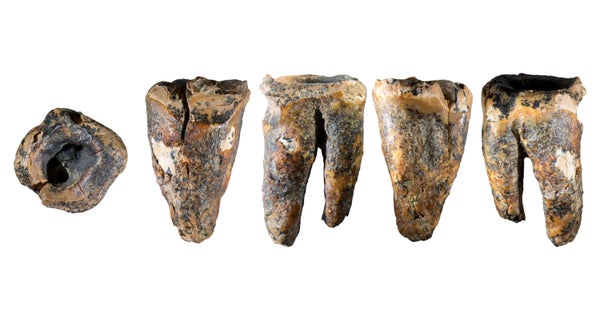
No one likes having their teeth drilled at the dentist. But hey, it could be worse. You could be a Neanderthal performing surgery on your own rotting molar with nothing but a shard of rock.
That’s the top-line finding from a new paper suggesting that Neanderthals performed dentistry almost 60,000 years ago. The discovery would mark the earliest evidence of dental work in a species of human and would predate evidence of dentistry in homo sapiens by more than 40,000 years.
Researchers analyzed a Neanderthal tooth that they say bears the unmistakable damage of intentional drilling. If that’s true, it may be early evidence of complex logical thought in Neanderthals, says archaeologist Lydia Zotkina, a co-author of the new paper.
On supporting science journalism
If you're enjoying this article, consider supporting our award-winning journalism by subscribing. By purchasing a subscription you are helping to ensure the future of impactful stories about the discoveries and ideas shaping our world today.
“It is the oldest evidence of this kind of behavior,” says Matthew Skinner, a paleoanthropologist at the Max Planck Institute for Evolutionary Anthropology in Leipzig, Germany, who was not involved in the research, adding that it “provides insights on the cognitive abilities of Neanderthals.” But other experts say the apparent discovery may not be so clear-cut. Christopher Dean, an emeritus professor of anatomy at University College London, who was also not involved in the study, says the hole could have been caused by an injury or some other trauma, while the scratch marks could have come from a crude toothpick—which previous discoveries suggest Neanderthals used.
The tooth was uncovered in Russia’s Chagyrskaya Cave, the discovery site of a number of stone-sharpened tools from the same time period. The molar has an enormous vertical hole through the crown and down to the pulp. When one of Zotkina’s colleagues, archaeologist Ksenia Kolobova, saw a pattern of circular marks lining the hole that were similar to those made by early human dental work, Zotkina was intrigued.
To try and re-create what might have happened to the tooth, she fixed modern human teeth (which are smaller but easier to get than Neanderthal teeth) in a cork to simulate the soft tissue of gums and hand-drilled them using small jasper shards such as those found in Chagyrskaya Cave. One of the teeth she used was a molar from her own mouth. “I had to have a tooth removed, so why not?” she says. “I asked the dentist if it was possible to keep it.”
Looking at her handiwork under a microscope, Zotkina and her colleagues saw very similar lesions to those in the ancient Neanderthal molar. They concluded that the Neanderthal, likely in enormous pain from the tooth’s decay, made the decision to drill through it and into the pulp beneath—if so, that represents a significant cognitive leap, says Léon Pariente, a Paris dentist who has consulted on archaeological findings, but was not involved in the study.
“The only way to stop the pain in a case of irreversible pulpitis is to physically open the pulp chamber, which immediately releases the pressure,” Pariente says. “I do not think it is obvious when you experience pulpitis that drilling through a very painful tooth can stop the pain.” He notes that such treatments didn’t appear in scientific literature until 1728.
To Zotkina, the tooth is a piece in the mounting body of evidence that Neanderthals were capable of forethought and reasoning. “He probably did it based on instinct, but it’s not only instinct,” she says. “It shows that they had cognition more or less of the same type as humans.”
The scrapes on the Neanderthal’s tooth were more muted and worn than Zotkina’s lab-chiseled lesions, which suggests to her that the Neanderthal’s endurance paid off. “It was also a functioning tooth afterwards, so it was a successful surgery,” she says. “He continued to use it, which wore away many of the markings.”
But while the markings on the tooth do seem to suggest tool use, University College London’s Dean says, he isn’t ready to rule out other explanations for the mammoth molar. “Such rapidly progressing dental decay in just one back tooth seems unlikely to me,” he says. Dean suggests that the hole could have formed through injury—such as by unexpectedly biting on a small stone—followed by years of decay.
The Neanderthal may have used a tool on the tooth long after it stopped hurting, perhaps to remove stuck food. “Some kind of modified toothpick that could be twisted round in the tooth seems more likely to me,” Dean says. Pariente also says the toothpick hypothesis may be more plausible than drilling. “The described tools and movements seem difficult for me to envision, especially if the individual is in pain and moving,” he says.
If this Neanderthal truly was their own dentist, Zotkina says, that also suggests they were extremely brave. “This guy was made of steel—someone who had so much courage,” she says. “Can you imagine the pain?”