
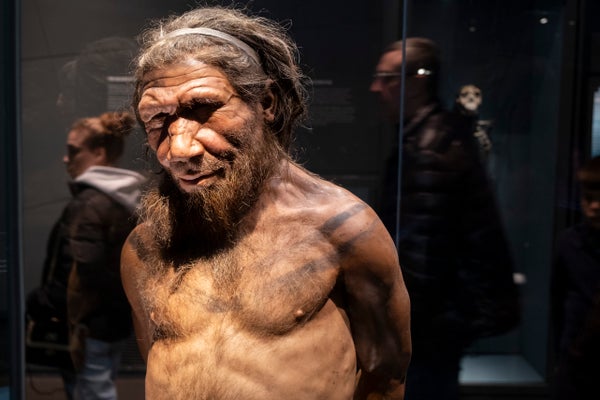
Most people today have a little Neanderthal DNA sprinkled through their genome. These genomic signals are the telltale signs that overlapping populations of ancient anatomically modern humans and Neanderthals had sex. Exactly what these interactions looked like is a mystery, but a new study suggests that when our species and Neanderthals did interbreed, it was primarily between male Neanderthals and anatomically modern female humans.
There’s less Neanderthal DNA on humans’ X chromosome than there is on most other chromosomes today. There were other theories as to why that might be, including the possibility that there was some evolutionary disadvantage to the Neanderthal X chromosome in humans.
“Our study allowed us to distinguish between these possibilities,” says Sarah Tishkoff, a professor of genetics and biology at the University of Pennsylvania and a co-author on the study.
On supporting science journalism
If you're enjoying this article, consider supporting our award-winning journalism by subscribing. By purchasing a subscription you are helping to ensure the future of impactful stories about the discoveries and ideas shaping our world today.
The researchers compared ancient Neanderthal DNA with that of people living in Africa today who have little or no Neanderthal ancestry.
If mixing anatomically modern human and Neanderthal DNA was disadvantageous, the scientists theorized, Neanderthal genomes would show large gaps devoid of human DNA similar to the lack of Neanderthal DNA on the X chromosomes of today’s H. sapiens, explains Alexander Platt, a senior research scientist at University of Pennsylvania and the study’s lead author. “But that wasn’t what we found,” he says.
Instead there was much more anatomically modern human ancestry present on Neanderthal X chromosomes than the researchers had expected, including on regions that had nothing to do with fitness. This suggested that the conspicuous absence of Neanderthal DNA in parts of the genomes of humans today is likely a result of a strong sex bias in mating long ago.
The research was published on Thursday in the journal Science.
Scientists already had an inkling that this might be the case, Tishkoff explains. But it’s unclear why male Neanderthals might selectively mate with anatomically modern female humans, or vice versa. “One can only speculate!” Tishkoff says.
A major limitation of the study is that the team didn’t have a ton of Neanderthal DNA to work with—there is only a handful of high-quality Neanderthal genomes. And these genomes provide just a snapshot of what sex between Neanderthals and anatomically modern humans may have looked like at a point in time.
As anthropologists work to uncover more Neanderthal DNA in the fossil record, the anatomically modern human–Neanderthal genetic picture will get clearer, Platt says.
In more of a philosophical sense, the study shows the value of looking outside of human DNA to understand our own ancestry, Platt says.
“We don't just have to look in our own gene pool to find what happens to Neanderthal alleles when they came into our population,” he says. By looking at the other half of these interactions, at Neanderthals, “you get a much richer picture.”