
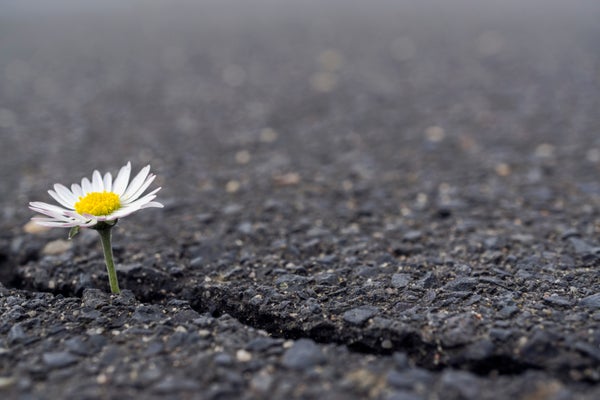

Kelly Clarkson reminds us that what doesn’t kill you makes you stronger, Elton John is still standing, and of course, Gloria Gaynor will survive. What’s the common thread? A little thing glinting in the eye of the tiger called resilience.
Resilience: it’s adapting and responding positively to stress and adversity. The adversity you face may be long-term, like having an alcoholic parent or growing up in poverty. Or it may be a single lightning strike of tragedy—a car accident that claims a limb, an assault that claims your dignity. Even first-world problems require a shot of micro-resilience, like when the person ahead of you snags the last blueberry scone (I’m talking to you, red beanie). No matter the scale of your tragedy, resilience is all in how you respond.
On supporting science journalism
If you're enjoying this article, consider supporting our award-winning journalism by subscribing. By purchasing a subscription you are helping to ensure the future of impactful stories about the discoveries and ideas shaping our world today.
Resilience has gotten some pushback recently. By encouraging “resilience,” detractors say, we imply that setbacks are exclusively individual, when in fact they often come from systemic barriers, like racism, sexism, economic inequality, or other injustices.
The answer? As with many things, it’s complicated. The solution to systemic injustice shouldn’t be to expect each individual to pull themselves out despite tractor-beam-like forces pulling them back. At the same time, resilience isn’t an empty idea: individuals can and do respond differently to the problems life dishes up.
Importantly, resilience is a skill, not a you-have-it-or-you-don’t trait, which means whether you sink or swim is a skill that can be taught. So what can you do? Here are 6 ways to make like a rubber band and bounce back.